
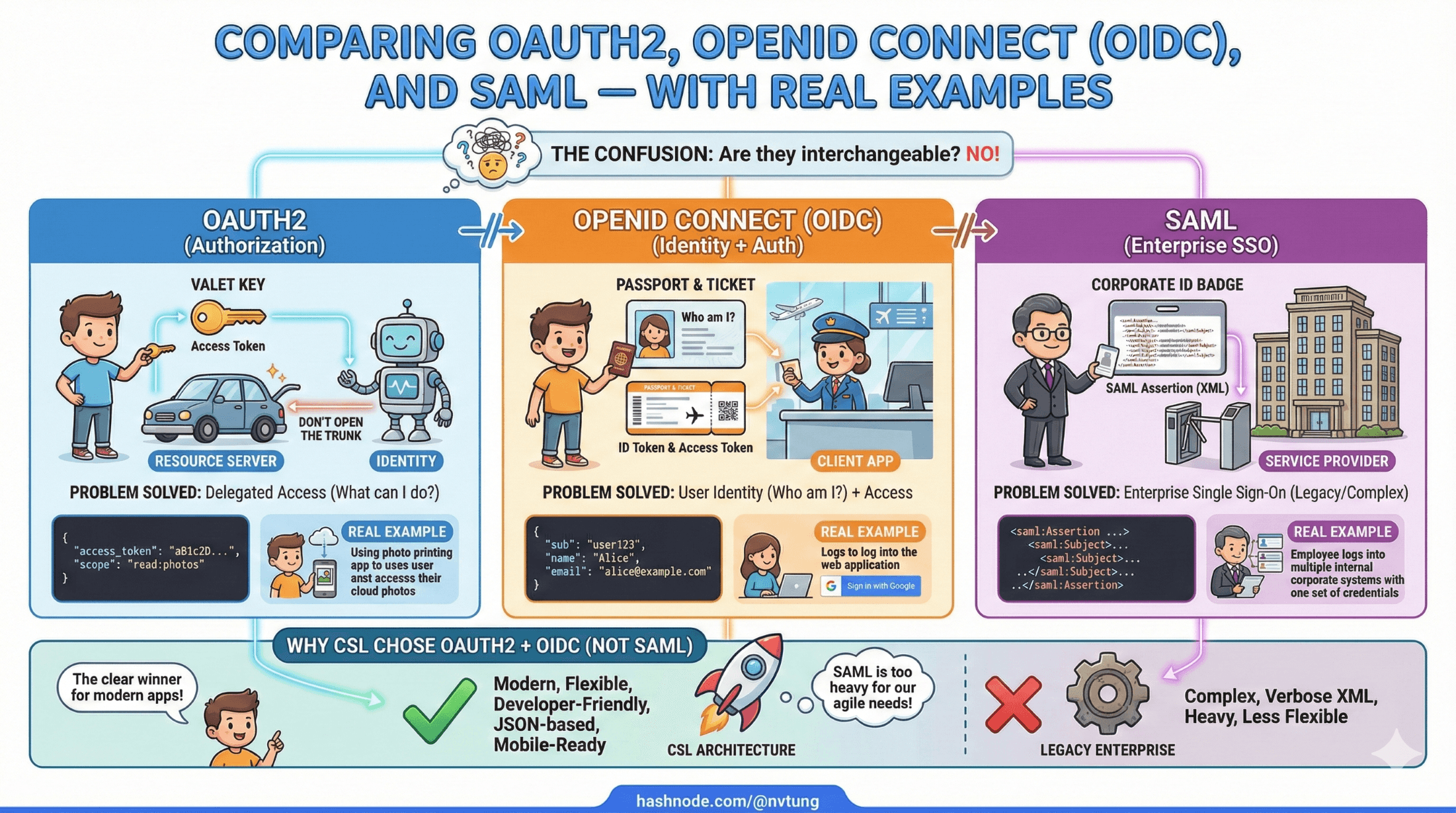
Comparing OAuth2, OpenID Connect (OIDC), and SAML — With Real Examples
A practical comparison of OAuth2, OpenID Connect, and SAML—what problems they solve, how they work, and when to use each.
Series: Web Authentication Demystified — From Concepts to Real-World
If there’s one source of confusion in authentication discussions, it’s this:
people often talk about OAuth2, OIDC, and SAML as if they’re interchangeable. They aren’t. They solve related problems, but at different layers, with different assumptions, and very different ergonomics.
This article clarifies how these standards compare by answering three practical questions:
What problem does each one actually solve?
What does it look like when used in a real system?
Why I chose OAuth2 + OIDC—and not SAML—for my real web app (CSL) implemented architecture?
The Core Differences (High-Level)
Before diving into flows and code, it helps to anchor each technology to its true purpose:

OAuth2 → delegated authorization
OIDC → authentication (identity) built on OAuth2
SAML → enterprise SSO protocol (authentication + attributes)
A useful mental model:
OAuth2 answers “what is this app allowed to do?”
OIDC answers “who is this user?”
SAML answers “can this enterprise user access this system?”
OAuth2: Delegated Authorization
What OAuth2 Is (and Is Not)
OAuth2 is not an authentication protocol.
It does not define users, logins, or identity.
OAuth2 defines how a client obtains an access token that grants permission to call an API on someone else’s behalf.
Real-World OAuth2 Example
Imagine CSL needs to call a government API to fetch teaching schedules.
The teacher logs in once, consents, and CSL receives an access token.
POST /token
Content-Type: application/x-www-form-urlencoded

grant_type=authorization_code
&code=AUTH_CODE
&client_id=CSL_APP
&client_secret=SECRET
&redirect_uri=https://csl.example.com/callback
Response:
{
  "access_token": "eyJhbGciOiJSUzI1NiIs...",
  "token_type": "Bearer",
  "expires_in": 900,
  "scope": "schedule.read"
}
CSL uses this token to call the API:
GET /api/schedules
Authorization: Bearer eyJhbGciOiJSUzI1NiIs...
What OAuth2 Does Well
Secure API access
Fine-grained scopes
Machine-to-machine authorization
Delegation without sharing passwords
What OAuth2 Does Not Do
Define who the user is
Standardize identity claims
Guarantee authentication semantics
This is why OAuth2 alone is insufficient for login systems.

OpenID Connect (OIDC): Authentication on Top of OAuth2
What OIDC Adds
OIDC layers identity on top of OAuth2 by introducing:
ID Tokens (standardized JWTs)
User identity claims
Nonce-based replay protection
UserInfo endpoint
Well-known discovery
In short:
OIDC turns OAuth2 into a login system.
Real-World OIDC Example (CSL Login)
In CSL, when a teacher clicks “Login with Government Identity”:
The browser is redirected to
/authorizewithscope=openidThe IdP authenticates the teacher
CSL receives an authorization code
CSL exchanges it for tokens
Response:
{
  "access_token": "...",
  "id_token": "eyJhbGciOiJSUzI1NiIs...",
  "expires_in": 900
}
Decoded id_token:
{
  "iss": "https://idp.example.gov",
  "sub": "teacher-98231",
  "aud": "CSL_APP",
  "email": "linh.nguyen@example.gov",
  "name": "Nguyen Van A",
  "exp": 1733683200
}
CSL then:
validates the token
maps
subto a local usercreates a PHP session
discards the token from frontend exposure
Why OIDC Fits Modern Systems
Standardized identity model
JWT-based, API-friendly
Mobile- and SPA-compatible
Works well with microservices
Easy integration with modern IdPs
OIDC is why “Login with Google” works everywhere today.

SAML: Enterprise Identity Federation
What SAML Is
SAML (Security Assertion Markup Language) is an XML-based identity federation protocol created long before OAuth2.
It focuses on:
enterprise SSO
centralized identity providers
strong trust relationships
browser-based authentication
SAML does not use tokens or APIs the way OAuth2/OIDC does.
Real-World SAML Example
A university employee accesses an internal HR portal.
Flow:
User accesses the app
App redirects to enterprise IdP
IdP authenticates user
IdP sends a signed XML assertion back via POST
App validates the assertion and creates a session
Example SAML assertion (simplified):
<saml:Assertion>
  <saml:Subject>
    <saml:NameID>teacher-98231</saml:NameID>
  </saml:Subject>
  <saml:AttributeStatement>
    <saml:Attribute Name="email">
      <saml:AttributeValue>linh.nguyen@example.gov</saml:AttributeValue>
    </saml:Attribute>
  </saml:AttributeStatement>
</saml:Assertion>
Strengths of SAML
Extremely mature
Widely used in enterprises
Strong trust guarantees
Well-suited for internal corporate apps
Weaknesses of SAML
XML complexity
Harder to debug
Poor mobile and SPA support
Not API-friendly
Heavy configuration burden
SAML shines in closed enterprise environments—but struggles in modern web architectures.

Side-by-Side Comparison
| Aspect | OAuth2 | OIDC | SAML |
| Primary purpose | Authorization | Authentication | Enterprise SSO |
| Identity support | ❌ | ✅ | ✅ |
| Token format | Any | JWT | XML |
| API-friendly | ✅ | ✅ | ❌ |
| Mobile / SPA | ⚠️ | ✅ | ❌ |
| Browser-based | ⚠️ | ✅ | ✅ |
| Enterprise legacy | ❌ | ⚠️ | ✅ |
| Modern ecosystem | ✅ | ✅ | ❌ |

Why CSL Chose OAuth2 + OIDC (Not SAML)

CSL needed:
modern API-based identity
government IdP compatibility
clean backend integration
no XML parsing
CDN compatibility
session-based PHP architecture
future extensibility
OIDC delivered all of this.
SAML would have:
increased complexity
limited extensibility
made API access harder
conflicted with modern cloud-native patterns
How All Three Can Coexist

In many organizations:
SAML handles internal enterprise SSO
OIDC handles external apps and APIs
OAuth2 handles service-to-service access
They are not mutually exclusive—they’re layered tools.
Choosing the Right One: Practical Guidance

Use OAuth2 if:
you’re securing APIs
users are not involved
services need delegated access
Use OIDC if:
users need to log in
modern apps or mobile clients are involved
you want standardized identity claims
Use SAML if:
you’re integrating with legacy enterprise IdPs
browser-only apps
corporate intranets
government systems that mandate it
Final Thoughts
OAuth2, OIDC, and SAML are not competing technologies—they’re solutions to different problems that emerged at different times. Understanding why each exists makes choosing between them straightforward.
In CSL, OAuth2 provided the authorization foundation, OIDC delivered modern identity, Redis-backed sessions ensured secure local control, and CloudFront signed cookies extended authorization to the CDN layer. Together, they formed a cohesive system that balances modern standards with real-world constraints.