
RabbitMQ as the Inter-Module Backbone in Datahub
How RabbitMQ enables decentralized communication between modules
Series: Designing a Microservice-Friendly Datahub
PART III — CASE STUDY: MY CSL DATAHUB IMPLEMENTATION
Previous: The .NET Processor: Orchestration and Translation in Datahub
Next: End-to-End Data Flow Scenarios in Datahub
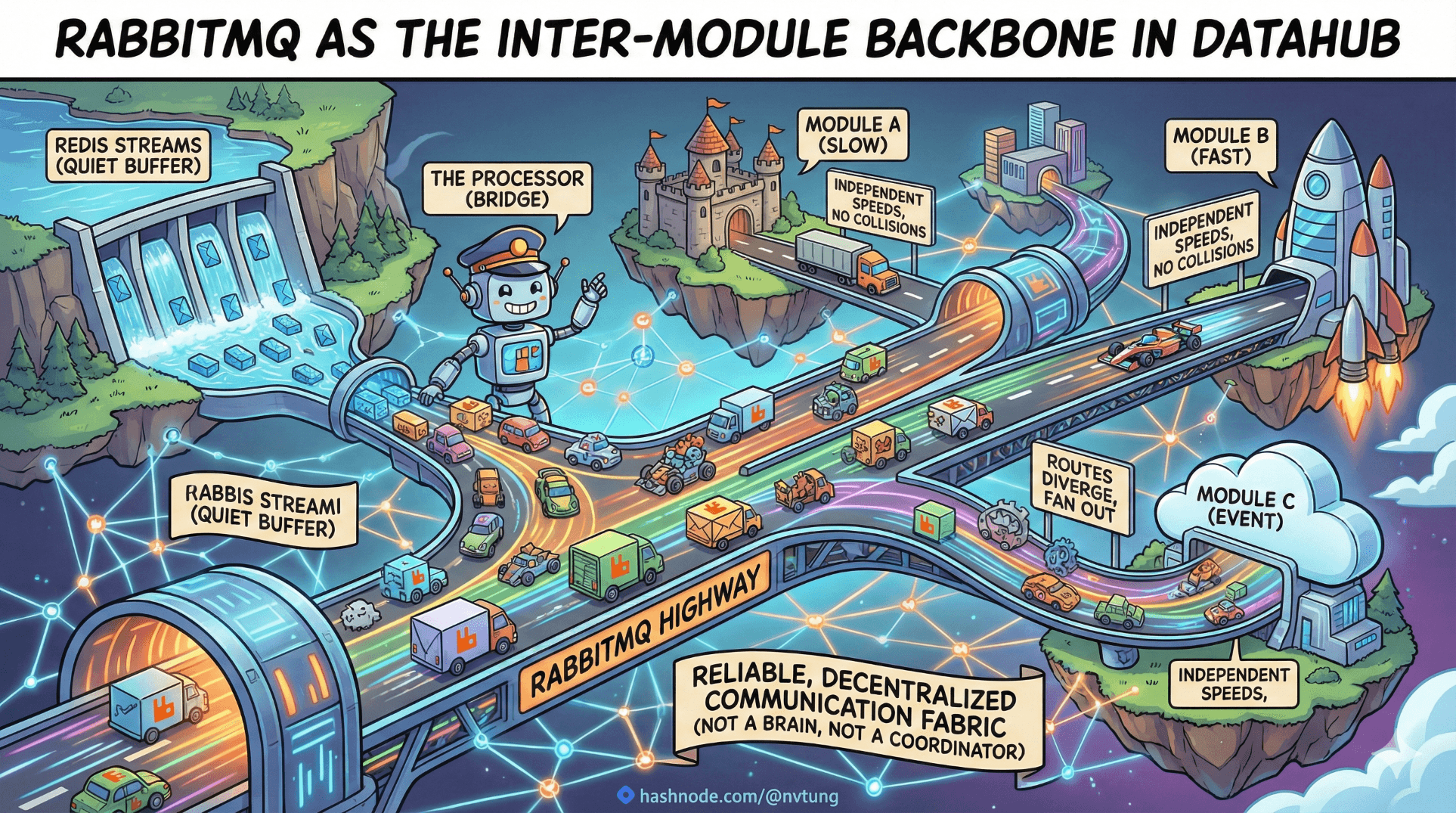
If Redis Streams are the quiet buffer and the Processor is the bridge, RabbitMQ is the highway—the place where events fan out, routes diverge, and independent modules move at their own speed without colliding.
This article explains how RabbitMQ functions as the inter-module backbone in the CSL Datahub: not as a coordinator, not as a brain, but as a reliable, decentralized communication fabric.
Disclaimer (Context & NDA)
The CSL Datahub implementation described here was designed and built in 2021. While the architectural principles remain valid, specific configurations or libraries could be updated today. To comply with NDA requirements, domain-specific payloads, schemas, and proprietary workflows are intentionally generalized.
Why RabbitMQ Sits at the Center (But Doesn’t Control)
RabbitMQ’s job in the CSL Datahub is deliberately narrow:
Accept published events
Route them based on declared rules
Deliver them reliably to consumers
It does not:
Enforce business meaning
Orchestrate workflows
Decide who should react
That restraint is what allows the system to scale.

RabbitMQ is logically central but behaviorally neutral.
Exchanges: Where Routing Decisions Live
In RabbitMQ, producers do not send messages to queues. They send messages to exchanges.
An exchange answers one question only:
“Given this message, which queues should receive it?”
In CSL, a topic exchange is commonly used:
channel.ExchangeDeclare(
    exchange: "csl.events",
    type: ExchangeType.Topic,
    durable: true
);
Topic exchanges allow routing by pattern, which is essential for multi-module systems.
Routing Strategies: Meaningful Keys, Not Magic Strings
Routing keys encode what happened, not who should react.
Example routing keys:
user.updateduser.createdorder.completedprofile.*
Publishing looks like this:
channel.BasicPublish(
    exchange: "csl.events",
    routingKey: "user.updated",
    body: Serialize(message)
);
The producer doesn’t know—or care—who is listening.
That ignorance is a feature.
Consumers in Other Modules: Opt-In, Not Coupled
Each external module declares its own queue and binds it to the exchange using patterns it cares about.
Example (Node.js):
channel.assertQueue('notifications.user', { durable: true });

channel.bindQueue(
  'notifications.user',
  'csl.events',
  'user.*'
);
Another module might bind more narrowly:
channel.bindQueue(
  'analytics.user',
  'csl.events',
  'user.updated'
);
No coordination required.
No shared code.
No shared database.
Each consumer opts in.
Publish/Subscribe in Practice
This is pub/sub without central planning:
One event is published
Many modules receive it
Each reacts independently
None block the others
If one consumer:
Is slow → its queue grows
Is down → messages wait
Is buggy → only it suffers
The rest of the system continues.

That isolation is the foundation of reliability.
Message Flow Patterns You Actually See in Production
RabbitMQ supports many patterns. In CSL, a few dominate.

1. Fan-Out (Broadcast)
One event, many consumers.
Used for:
State changes
Notifications
Cache invalidation
Read model updates
2. Selective Subscription
Consumers bind narrowly.
Used for:
Domain-specific reactions
Reduced noise
Ownership clarity
3. Asymmetric Load
Different consumers process at different speeds.
RabbitMQ absorbs this naturally via queues.
Decentralized Consumption Is the Point
No service knows:
How many consumers exist
Who owns which reactions
What downstream logic looks like
This avoids:
Release coordination
Dependency graphs
“Who broke whom?” debates

Decentralization is not chaos—it’s delegated responsibility.
A Note on Acknowledgements and Safety
Consumers explicitly acknowledge messages:
channel.consume(queue, msg => {
  try {
    handle(msg);
    channel.ack(msg);
  } catch (e) {
    channel.nack(msg, false, false);
  }
});
This enables:
At-least-once delivery
Retries via requeue or DLQ
Controlled failure handling
RabbitMQ does not assume success. Neither should you.
Why This Scales With Teams, Not Just Traffic
As organizations grow:
Teams want autonomy
Release cycles diverge
Responsibilities fragment
RabbitMQ supports this naturally:
Teams add consumers without permission
Teams remove consumers without coordination
Teams scale independently

The architecture scales organizationally, not just technically.
Common Pitfalls (And How CSL Avoids Them)
Overloading routing keys → keep them semantic, not procedural
Central “listener” services → let modules consume directly
Business logic in the broker → never
Synchronous dependencies → avoid at all costs

RabbitMQ is powerful—but only when kept simple.
Mental Model Recap
Think of RabbitMQ as:
A switchboard, not a controller
A router, not a decision-maker
A broadcaster, not a coordinator
When events enter RabbitMQ, ownership dissolves. Reactions belong to whoever chooses to listen.
Where We Go Next
Now that events are published, routed, and consumed across modules, the final step is to see the whole system in motion.
In the next article, End-to-End Data Flow Scenarios, we’ll trace real flows—from a user action in the CSL Web App, through Redis and RabbitMQ, to multiple reacting modules—so you can watch the Datahub work from start to finish.
Communication at scale isn’t about control.
It’s about letting the right conversations happen—everywhere, safely.