
Redis Streams as an Event Buffer in Datahub
How Redis Streams protect the core system and absorb pressure
Series: Designing a Microservice-Friendly Datahub
PART III — CASE STUDY: MY CSL DATAHUB IMPLEMENTATION
Previous: The Web App of my CSL Datahub implementation
Next: The .NET Processor: Orchestration and Translation in Datahub
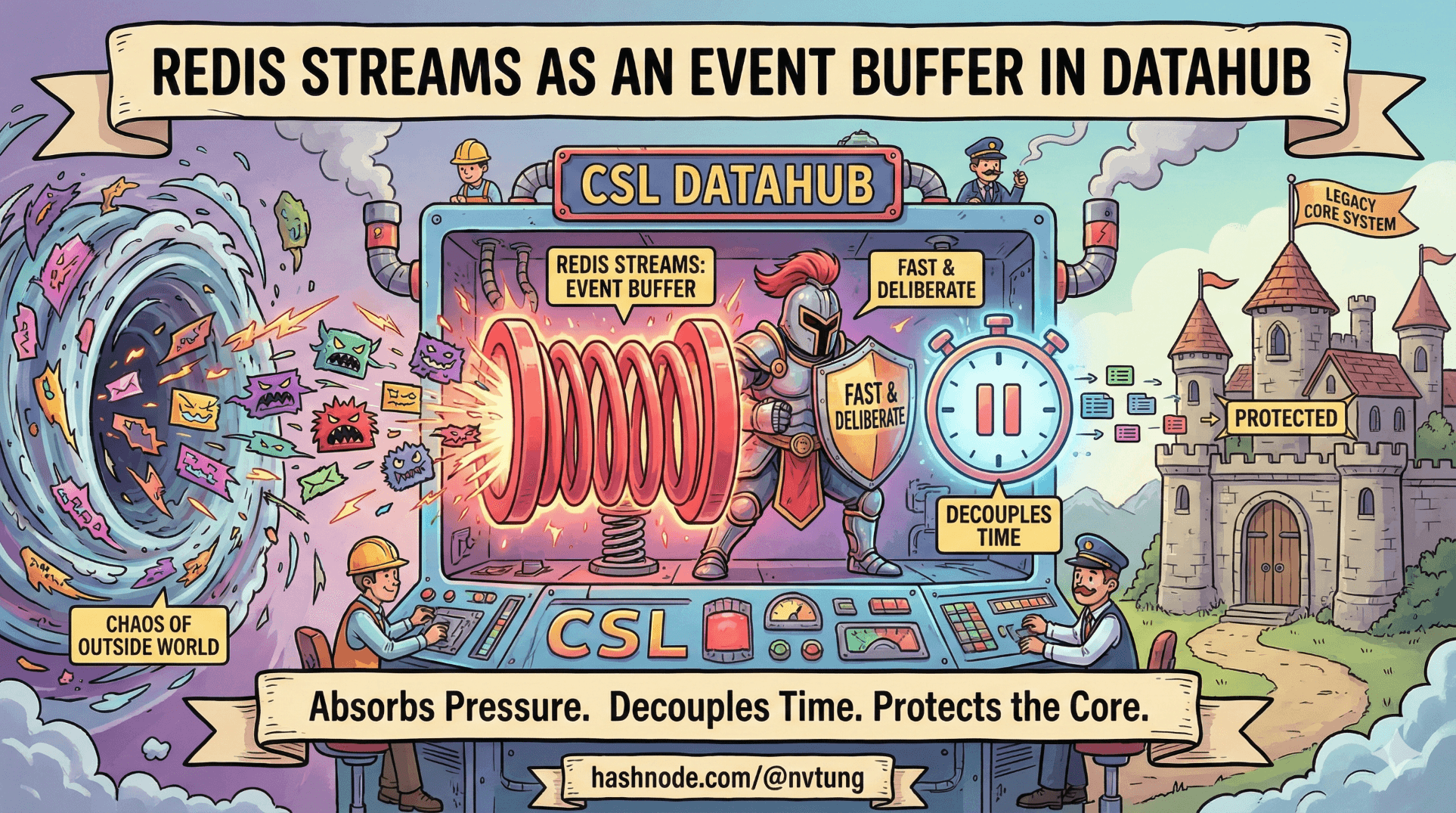
Redis is famous for being fast. That reputation can make architects nervous: fast is often mistaken for fragile. In my CSL Datahub implementation, Redis Streams play a deceptively modest role—but that role is critical. They are the event buffer that absorbs pressure, decouples time, and protects the legacy core system from the chaos of the outside world.
This article explains why Redis Streams were chosen, how they work in practice, and why “fast” does not mean “reckless” when used deliberately.
Disclaimer (Context & NDA)
The CSL Datahub implementation discussed here was designed and built in 2021. While the architectural principles remain valid, some tooling choices could be updated today. To comply with NDA requirements, domain-specific logic, schemas, and sensitive details are intentionally generalized.
Why an Event Buffer Exists at All
Before naming any technology, let’s restate the need.
The CSL Web App must be able to:
Commit state quickly
Remain responsive under load
Avoid depending on downstream systems
Emit events without orchestrating outcomes
Downstream systems (processors, brokers, modules) must be able to:
Fall behind temporarily
Restart without data loss
Catch up deterministically
Those needs are in tension. An event buffer resolves that tension by inserting time and elasticity between producers and consumers.

Redis Streams fill that role.
Why Redis Streams Was Chosen
The choice was not “Redis vs Kafka” or “Redis vs RabbitMQ.” It was Redis Streams vs the actual constraints.
Redis Streams were chosen because they:
Were already available operationally
Offered append-only semantics
Supported consumer groups
Had predictable failure modes
Required minimal changes to the legacy PHP app

Most importantly, Redis behaves like local infrastructure from the perspective of the Web App. It’s fast, nearby, and familiar—qualities that matter when protecting a core system.
Streams, Not Queues: A Subtle but Important Distinction
Traditional queues:
Deliver messages
Remove them once consumed
Prioritize throughput over history
Streams:
Append entries immutably
Track consumption via offsets
Allow multiple consumers to read independently
In Redis Streams, data is not destroyed by reading it. Instead, consumers acknowledge progress.

That difference enables:
Replay
Debugging
Recovery after crashes
Clear visibility into lag
This makes Streams ideal as a buffer between a stateful producer and asynchronous consumers.
Producing Events from the Web App
From the CSL Web App’s point of view, emitting an event is deliberately boring:
$redis->xAdd(
    'csl:events',
    '*',
    [
        'type' => 'user.updated',
        'user_id' => $userId,
        'occurred_at' => time()
    ]
);
There is no routing.
There is no retry logic.
There is no consumer awareness.
The Web App’s only responsibility is to record the fact that something happened—quickly and safely.
Consumer Groups: Coordinated, Not Centralized
Redis Streams support consumer groups, which allow multiple consumers to split work without duplicating it.
A group is created once:
XGROUP CREATE csl:events csl-group $ MKSTREAM
Each Processor instance joins the group with its own consumer name:
var entries = redis.StreamReadGroup(
    "csl-group",
    "processor-1",
    "csl:events",
    ">"
);
Key properties:
Each event is delivered to one consumer in the group
Progress is tracked per group, not per consumer
Consumers can come and go
Crashed consumers leave pending messages behind
This gives you horizontal scalability without central coordination.
Acknowledgement and Safety
Processing is explicit. After successful handling, the Processor acknowledges the message:
redis.StreamAcknowledge(
    "csl:events",
    "csl-group",
    entry.Id
);
If a Processor crashes before acknowledging:
The message remains pending
Another consumer can claim it
No data is lost
This is the foundation of at-least-once delivery.
Ordering and Durability (In Context)
Redis Streams provide:
Order within a stream
Timestamp-based IDs
Disk-backed persistence (via RDB/AOF)
What they do not promise:
Infinite retention
Global ordering across partitions
Historical analytics
And that’s fine—because the CSL Datahub doesn’t need those things at this layer.

Ordering here means:
“Changes are processed roughly in the order they occurred”
Not “the entire system depends on strict sequencing”
Durability here means:
“Events survive process restarts”
Not “events are archived forever”
This is right-sized reliability.
Backpressure: Letting the System Breathe
One of Redis Streams’ most valuable traits is how visibly they handle backpressure.
When consumers slow down:
Stream length grows
Pending entries accumulate
Lag becomes measurable
Nothing explodes. Nothing blocks the Web App. Pressure accumulates where it belongs—in the buffer.
This turns overload into latency instead of failure.

Operationally, this is gold:
You can alert on lag
Scale consumers horizontally
Investigate without panic
Backpressure is not a bug. It’s a signal.
Fast Doesn’t Mean Reckless
Redis is fast because it does less—not because it does unsafe things.
Used correctly, Redis Streams:
Avoid business logic
Avoid orchestration
Avoid cross-system coupling
They act as a shock absorber, not a coordinator.

The danger is not Redis itself—it’s overloading Redis with responsibilities it was never meant to carry.
Streams vs Queues: When to Use Which
Use streams when:
You need buffering, not history
You want replay and visibility
You expect consumer lag
You value simplicity
Use queues when:
Messages are ephemeral
You don’t care about replay
Routing is the primary concern

In the CSL Datahub, Redis Streams buffer. RabbitMQ routes. Each tool does one job.
Redis Beyond Caching
This is the quiet triumph of Redis Streams.
They allow Redis to:
Be part of an event-driven architecture
Absorb pressure gracefully
Enable decoupling without heavy infrastructure

Redis doesn’t replace the message broker. It protects the producer.
And that makes all the difference.
Where We Go Next
Now that events are safely buffered, the next step is transformation.
In the next article, The CSL Processor: Translation and Orchestration, we’ll look at how buffered events are consumed, enriched, retried, and forwarded—without turning the Processor into a “God service.”
Redis Streams don’t get credit for being exciting.
They get credit for keeping everything else calm.