
Dead Letter Queues and Retry Strategies
Designing safe failure and recovery in event-driven systems
Series: Designing a Microservice-Friendly Datahub
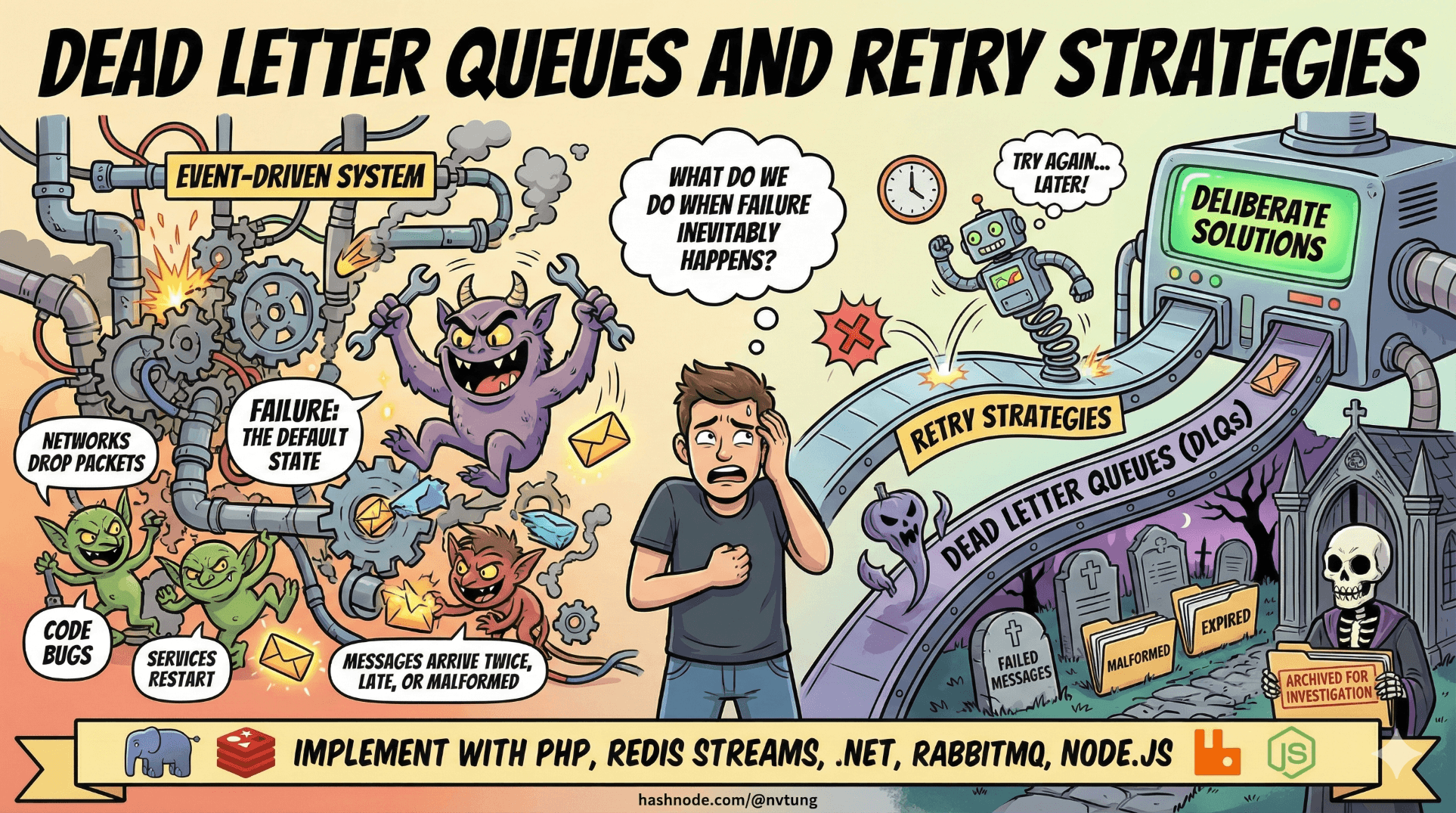
In event-driven systems, failure is not an edge case—it’s the default state waiting to happen. Networks drop packets. Services restart. Code contains bugs. Messages arrive twice, late, or malformed.
The question is not “How do we prevent failure?”
The real question is “What do we do when failure inevitably happens?”
Dead Letter Queues (DLQs) and retry strategies are the answer—but only when used deliberately. This article explains why they exist, how they work, and how to implement them correctly using the same tools you’ve seen throughout this series: PHP, Redis Streams, .NET, RabbitMQ, and Node.js.
The Core Principle: Failure Is Normal
In synchronous systems, failure is immediate and obvious.
In asynchronous systems, failure is deferred—and that makes it more dangerous.
Without explicit failure handling:
Messages disappear
Pipelines stall silently
State diverges slowly
Bugs surface days later

DLQs exist to make failure visible, contained, and reversible.
What Is a Dead Letter Queue (Really)?
A Dead Letter Queue is not a trash bin.
It is:
A quarantine zone for unprocessable messages
A pressure-release valve for pipelines
A forensic record of what went wrong
Messages land in a DLQ when:
They fail processing too many times
They are structurally invalid
They are “poison messages” (always fail)

Nothing should land in a DLQ silently.
Retry vs DLQ: Know the Difference
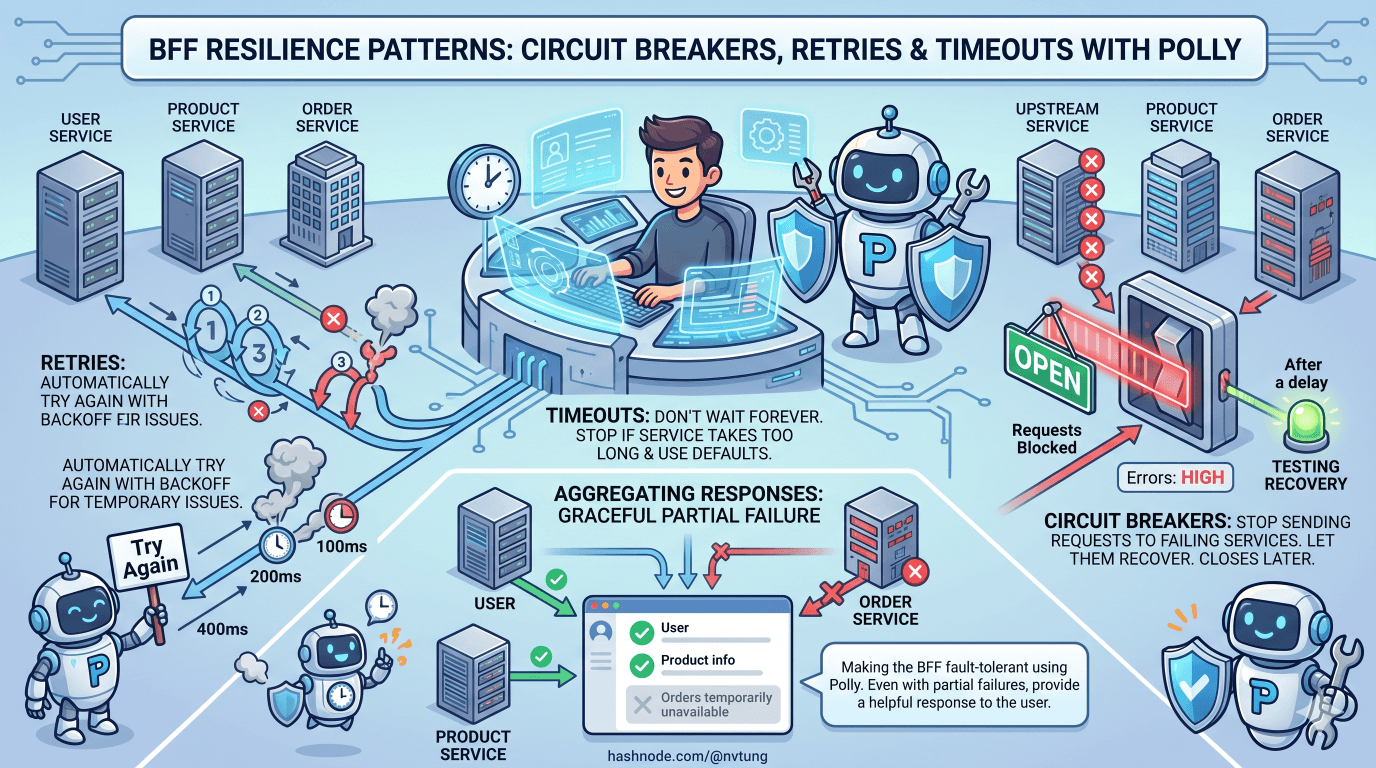
Retries are for temporary failures
Network timeouts
Service restarts
Rate limits
Brief unavailability
DLQs are for deterministic failures
Invalid payloads
Unsupported event versions
Missing required data
Logic bugs

Retrying deterministic failures forever is how queues die.
Retry Strategy Fundamentals
A good retry strategy answers three questions:
When should we retry?
How often should we retry?
When do we stop retrying?

The correct answers are never “immediately,” “forever,” and “we’ll see.”
RabbitMQ: DLQs and Retries in Practice
RabbitMQ makes DLQs explicit—and that’s a good thing.
Step 1: Declare a Dead Letter Exchange
channel.ExchangeDeclare(
    exchange: "events.dlx",
    type: ExchangeType.Topic,
    durable: true
);
Step 2: Configure the Main Queue With DLQ Rules
var args = new Dictionary<string, object>
{
    { "x-dead-letter-exchange", "events.dlx" },
    { "x-dead-letter-routing-key", "user.updated.failed" }
};

channel.QueueDeclare(
    queue: "user.updated.consumer",
    durable: true,
    exclusive: false,
    autoDelete: false,
    arguments: args
);
If a message is rejected or expires, RabbitMQ moves it automatically.
Step 3: Consumer Logic With Explicit Failure
consumer.Received += (sender, ea) =>
{
    try
    {
        HandleMessage(ea.Body);
        channel.BasicAck(ea.DeliveryTag, false);
    }
    catch (TransientException)
    {
        // retry
        channel.BasicNack(ea.DeliveryTag, false, true);
    }
    catch (Exception)
    {
        // poison message → DLQ
        channel.BasicNack(ea.DeliveryTag, false, false);
    }
};
This is the critical distinction:
requeue = true→ retryrequeue = false→ DLQ
Adding Retry Backoff (Without Melting the System)
Immediate retries are dangerous. They create retry storms.
A common RabbitMQ pattern uses delay queues.
Retry Queue With TTL
var retryArgs = new Dictionary<string, object>
{
    { "x-message-ttl", 10000 }, // 10 seconds
    { "x-dead-letter-exchange", "events" },
    { "x-dead-letter-routing-key", "user.updated" }
};

channel.QueueDeclare(
    queue: "user.updated.retry",
    durable: true,
    exclusive: false,
    autoDelete: false,
    arguments: retryArgs
);
Flow:
Failure → send to retry queue
TTL expires
Message returns to main queue
Retry occurs with delay
Backoff without code complexity.
Redis Streams: Handling Poison Messages
Redis Streams don’t have DLQs—but they have pending entries, which serve a similar purpose.
Consumer Group Pending Entries
If a consumer crashes before acknowledging:
XPENDING csl:events csl-group
You’ll see:
Message IDs
Idle time
Assigned consumer
Claiming Stuck Messages
XCLAIM csl:events csl-group processor-2 60000 1689745230000-0
If a message repeatedly fails after manual retries, you stop retrying it.
At that point:
Log it
Alert on it
Move it to a separate inspection stream
Redis forces you to think, not automate blindly.
Node.js Consumer Example With Retry Guard
try {
  await handleEvent(event);
} catch (err) {
  if (isTransient(err)) {
    throw err; // retry via requeue
  }

  await publishToDLQ(event);
}
Retry logic lives in code, but exit paths are explicit.
Poison Messages: The Silent Queue Killers
A poison message:
Always fails
Always retries
Always blocks progress
Symptoms:
Queue lag never decreases
Consumers look “healthy”
Throughput collapses

DLQs exist to sacrifice poison messages so healthy traffic survives.
Visibility Is Non-Negotiable
DLQs without monitoring are mass graves.
You must:
Alert on DLQ growth
Inspect payloads
Track failure reasons
Decide: replay, fix, discard

A DLQ should trigger human attention—not be ignored.
Idempotency Makes Retries Safe
Retries only work if processing is idempotent.
INSERT INTO processed_events (event_id)
VALUES (:event_id)
ON DUPLICATE KEY UPDATE event_id = event_id;
Without this, retries create duplicate side effects.
With this, retries become boring.
Boring is reliability.
Common Anti-Patterns (Avoid These)
Infinite retries
No DLQ
Silent message drops
Treating DLQ as “done”
Retrying deterministic failures

Every one of these turns small bugs into outages.
A Simple Mental Model
Retry = “This might work later”
DLQ = “This needs attention”
Drop = “We accept data loss” (rarely acceptable)
Make the decision explicit. Never let it be accidental.
Closing Thought
Dead Letter Queues are not about pessimism.
They’re about engineering humility.
They acknowledge:
Code is imperfect
Systems fail
Humans need visibility
A system that fails loudly, visibly, and recoverably is far safer than one that pretends failure won’t happen.
Retries keep systems alive.
DLQs keep systems honest.
Both are required for real-world reliability.