
Redis as a Session Store for Scalable Web Architecture
How Redis enables fast, secure, and scalable session management in modern PHP-based web applications.
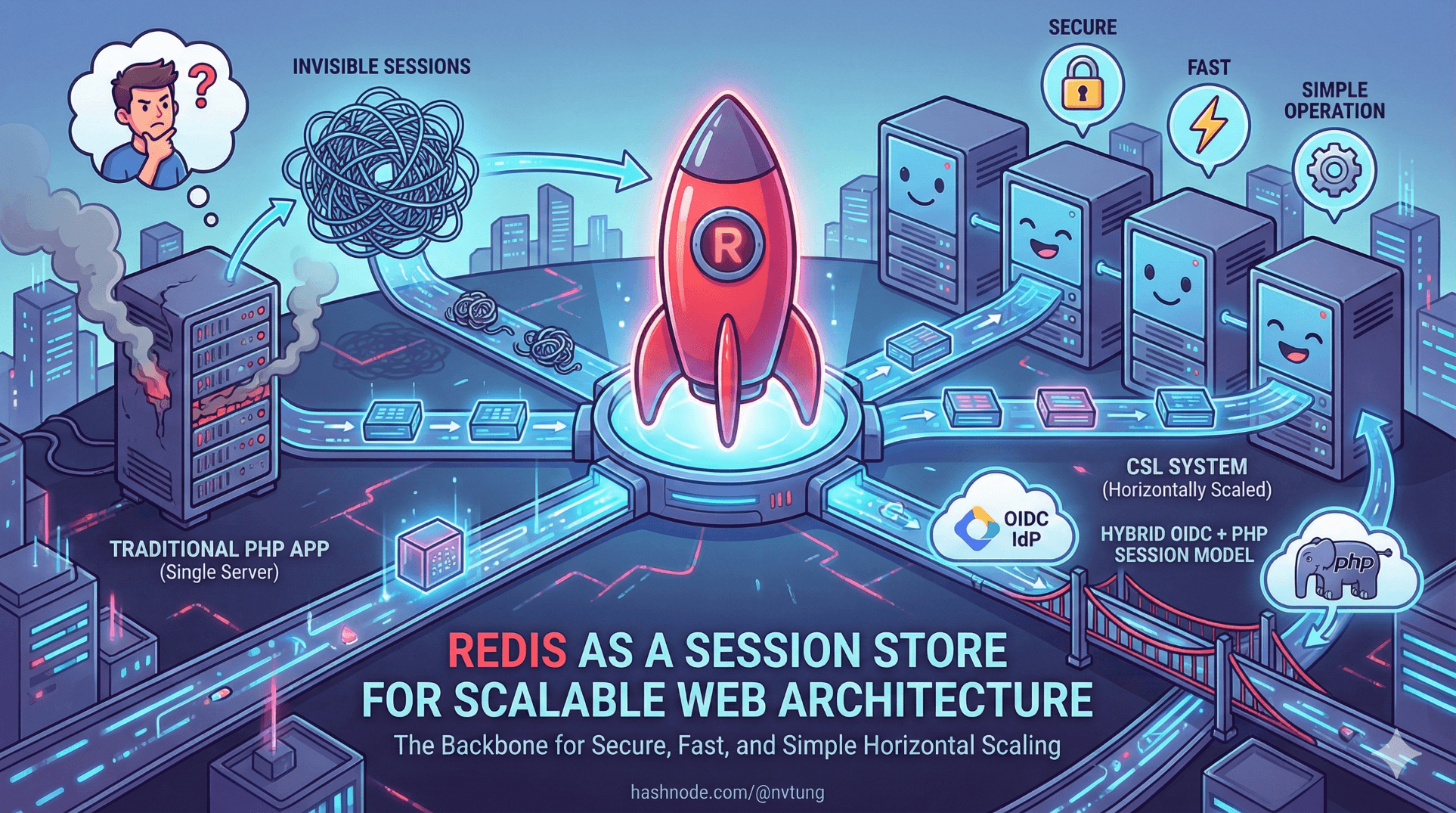
Series: Web Authentication Demystified — From Concepts to Real-World
In traditional PHP applications, sessions often feel invisible. You enable them, they work, and you move on. But once an application grows beyond a single server—especially when authentication is involved—where and how sessions are stored becomes a critical architectural decision.
In my CSL system (which is powered by a PHP framework - Yii, or more specifically, Humhub), Redis plays a central role: it is the backbone that allows a hybrid OIDC + PHP session model to scale horizontally while remaining secure, fast, and operationally simple.
This article explains:
why default file-based sessions don’t scale
how Redis changes the session model
how Yii/HumHub integrates with Redis sessions
what data is actually stored
how Redis enables instant logout and revocation
real-world pitfalls and best practices
The Problem with Traditional PHP Sessions
By default, PHP stores sessions as files on disk:
/tmp/sess_abcd1234
This works fine when:
you have one server
users don’t move between machines
traffic is low
But it breaks down quickly in modern environments.

Key Limitations
Sessions are local to one server
Load balancers must use sticky sessions
Horizontal scaling becomes painful
Session cleanup is slow and unreliable
Disk I/O becomes a bottleneck
Revoking sessions across servers is hard
In a system like CSL—with:
multiple app servers
Redis-backed auth
CloudFront
government IdP integration
file-based sessions simply aren’t enough.
Why Redis Is a Natural Fit for Sessions
Redis is an in-memory key–value store designed for speed, simplicity, and predictability.

For session storage, Redis offers exactly what we need:
shared state across servers
extremely fast reads/writes
built-in expiration (TTL)
atomic operations
simple data model
mature ecosystem
Instead of:
“Session lives on this server”
Redis enables:
“Session lives wherever Redis is reachable”
What a Redis-Backed Session Looks Like

Conceptually, a PHP session stored in Redis looks like this:
Key: humhub_sess_abcd1234
TTL: 3600 seconds
Value:
{
  "user_id": 4821,
  "role": "teacher",
  "login_time": 1733640000,
  "permissions": [...]
}
Important details:
The session ID remains in the browser (
PHPSESSID)The actual session data lives in Redis
Redis handles expiration automatically
Any app server can load the session
How Redis Fits into the CSL Authentication Flow
In CSL, Redis sessions are created after OIDC authentication succeeds.

The flow:
User authenticates via IdP
Backend validates token
Identity is mapped to local user
PHP session is created and stored in Redis
Browser receives
PHPSESSIDcookieEvery subsequent request:
browser sends
PHPSESSIDbackend loads session from Redis
Redis becomes the single source of truth for authenticated state.
Configuring Redis Sessions in Yii / HumHub
Yii provides first-class support for Redis-backed sessions.

A simplified configuration looks like this:
'components' => [
    'redis' => [
        'class' => 'yii\redis\Connection',
        'hostname' => 'redis.internal',
        'port' => 6379,
        'database' => 0,
    ],
    'session' => [
        'class' => 'yii\redis\Session',
        'redis' => 'redis',
        'keyPrefix' => 'humhub_sess_',
        'timeout' => 3600,
    ],
]
From this point on:
Yii::$app->sessiontransparently uses RedisNo code changes are needed in controllers
HumHub continues to work as-is
This is one of the reasons Redis works so well with legacy PHP systems.
Session Creation During Login (Real Example)

After OIDC authentication and identity mapping:
Yii::$app->user->switchIdentity($user, 0);

// Prevent session fixation
Yii::$app->session->regenerateID(true);

// Store useful context
Yii::$app->session->set('login_time', time());
Yii::$app->session->set('auth_source', 'government-idp');
Yii::$app->session->set('user_role', $user->role);
Redis automatically:
stores the session
sets TTL
replicates state across app servers
Why Redis Enables Horizontal Scaling

Without Redis:
each server holds its own sessions
users must stick to one server
With Redis:
any server can serve any request
load balancer can route freely
scaling is trivial
This makes Redis essential for:
autoscaling groups
containerized deployments
rolling deployments
blue/green releases
Instant Logout and Session Revocation
One of Redis’ biggest advantages is centralized revocation.

Logging out a user:
Yii::$app->session->destroy();
This immediately:
deletes the Redis key
invalidates the session everywhere
blocks access on all servers
Compare that to JWT-based systems, where tokens remain valid until expiration.
Session Expiration and TTL
Redis sessions naturally expire via TTL.

Typical strategies:
30–60 minutes idle timeout
session TTL refreshed on activity
absolute session lifetime enforced in code
Example:
Yii::$app->session->setTimeout(3600);
Redis handles cleanup automatically—no cron jobs, no disk sweeps.
Security Benefits of Redis Sessions

No Tokens in the Browser
Only a random session ID is stored in the cookie.
HttpOnly Cookies
JS cannot access session data.
Central Authority
The backend decides who is logged in.
Reduced Attack Surface
No JWT parsing, no token replay, no localStorage risks.
Redis vs JWT: A Practical Comparison

| Aspect | Redis Sessions | JWT |
| Stateless | ❌ | ✅ |
| Revocation | ✅ Immediate | ❌ Hard |
| Browser storage | Cookie ID | Token |
| XSS impact | Low | High |
| Scaling | ✅ | ✅ |
| PHP-friendly | ✅ | ⚠️ |
In CSL’s context, Redis sessions win decisively.
Operational Considerations

High Availability
Use Redis replication
Consider Redis Sentinel or managed Redis
Persistence
- Enable RDB or AOF to survive restarts
Memory Management
Set max memory
Use eviction policies carefully
Monitoring
Track memory usage
Track session count
Watch eviction events
Common Pitfalls to Avoid

Storing large blobs in session
Infinite TTL sessions
Relying on Redis as a database
Ignoring Redis downtime scenarios
Not regenerating session IDs on login
Why Redis Was the Right Choice for CSL
Redis allowed CSL to:
scale authentication horizontally
preserve PHP’s session model
integrate cleanly with OIDC
support instant logout
reduce frontend security risks
keep architecture simple and maintainable

It wasn’t a “modern” choice—it was a correct one.
Final Thoughts
Redis sessions sit quietly behind the scenes, but they’re one of the most important components in a secure, scalable web authentication system. In CSL, Redis bridges the gap between modern identity standards and a traditional PHP architecture—without forcing either side to compromise.