
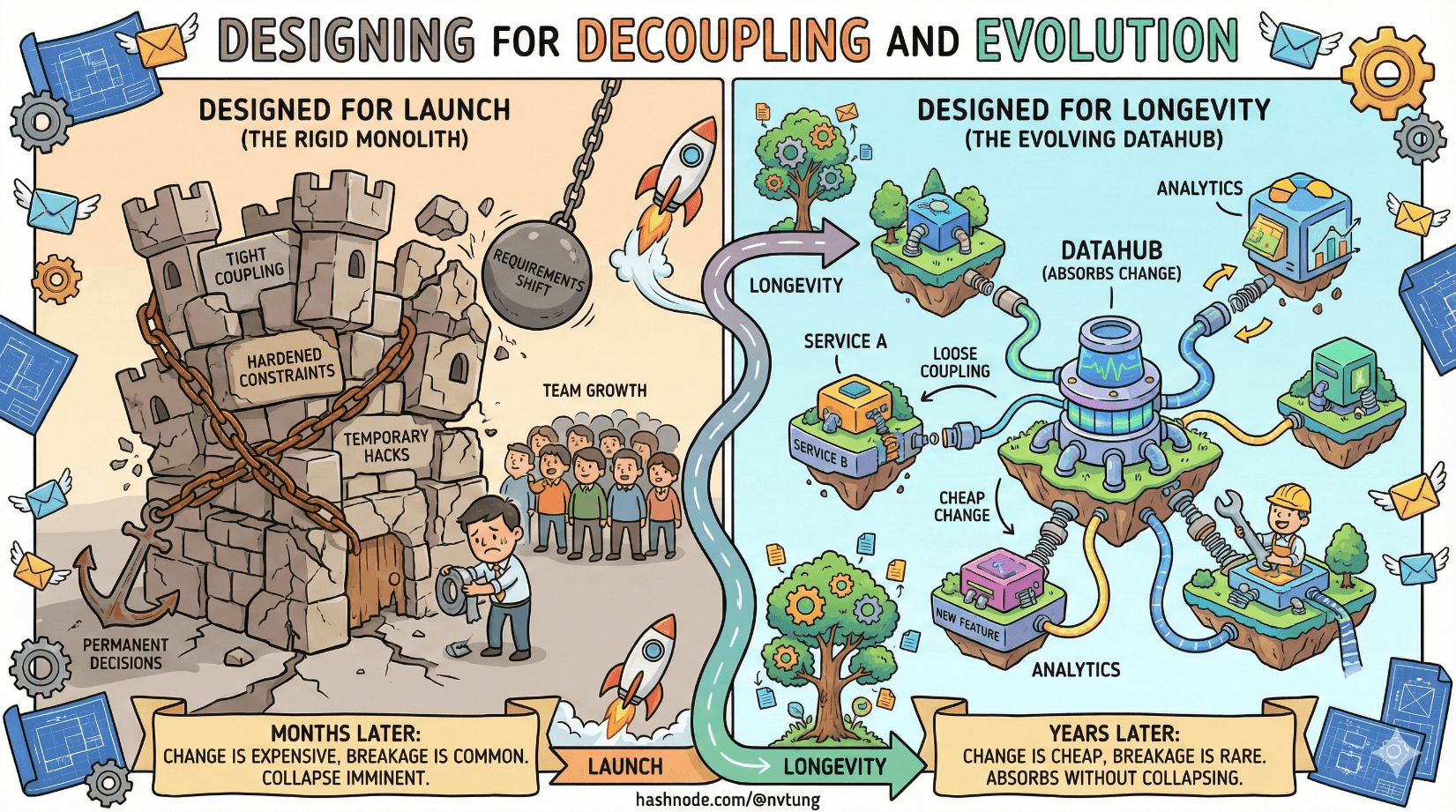
Designing for Decoupling and Evolution
How to build systems that evolve without breaking
Series: Designing a Microservice-Friendly Datahub
PART II — DESIGN PRACTICES: THE “HOW”
Previous: Datahub Technology Choices: Tools That Fit the Pattern
Next: Datahub: Reliability, Failure, and Observability
Most software architectures are designed for launch. Very few are designed for longevity.
The difference shows up months or years later, when requirements shift, teams grow, and yesterday’s “temporary” decisions harden into permanent constraints. Systems that survive this phase don’t do so because they predicted the future correctly—they survive because they made change cheap and breakage rare.
This article is about designing Datahub-based systems with that long view in mind. Not to prevent change—that’s impossible—but to absorb it without collapsing.
Start With the Only Certainty: Change
Features will change.
Data models will change.
Teams will change.
Interpretations will change.
What you can choose is where the cost of that change is paid.
Poorly designed systems push change costs outward:
onto consumers,
onto operations,
onto coordination meetings,
onto release freezes.

Well-designed systems localize change. They let evolution happen at the edges while the core remains stable.
That’s the heart of decoupling.
Avoiding Shared Databases: Ownership or Chaos
The fastest way to make change expensive is to let multiple services share the same database.
Shared databases:
Create invisible dependencies
Make schema changes political
Encourage shortcut integrations
Destroy ownership boundaries
They fail not because they’re technically unsound, but because they blur responsibility. When everyone depends on the same tables, no one can change them safely.

In a decoupled system:
Each service owns its data
Databases are private
Changes are announced as events
Consumers build their own derived views
This isn’t duplication—it’s intentional redundancy. Redundancy is what allows services to evolve independently.
Contract-Based Communication: Replace Assumptions With Agreements
Decoupling does not mean “anything goes.” It means explicit agreements instead of implicit assumptions.
In Datahub architectures, those agreements are contracts:
Event schemas
Message formats
API payloads
Semantic meaning
A contract answers three questions:
What data is being shared?
What does it mean?
What guarantees does the producer make?
Everything else is an implementation detail.

Loose coupling without contracts is chaos.
Tight coupling with contracts is still coupling.
Loose coupling with strong contracts is architecture.
Schemas Are APIs (Whether You Admit It or Not)
Teams often treat schemas as internal details and APIs as public interfaces. In event-driven systems, that distinction collapses.
An event schema is an API.
Once an event is published:
Someone will depend on it
Someone will parse it
Someone will store it
Someone will build logic around it

Changing a schema casually is equivalent to changing a public API without versioning. The damage just happens asynchronously.
If an event leaves your service boundary, it must be treated as a public contract.
Event Versioning: Designing for the Second Change
Most schemas aren’t broken by their first version. They’re broken by the second.

Event versioning exists because:
Fields get added
Meanings get refined
Edge cases emerge
Original assumptions fail
A versioned event might include:
A version field
A versioned topic or routing key
A new event type entirely
What matters is not the mechanism, but the discipline:
Never silently change meaning
Never break existing consumers
Never assume everyone upgrades at once
Backward Compatibility: The Unsung Hero
Backward compatibility is how decoupling survives reality.
In distributed systems:
Consumers deploy slower than producers
Some consumers are offline
Some consumers lag by weeks or months
If producers require consumers to update immediately, you’ve recreated tight coupling—just over a message broker.

Designing for backward compatibility means:
Add fields, don’t remove them
Make new data optional
Preserve old semantics
Let consumers opt in to new behavior
This isn’t generosity. It’s survival.
Consumers Move Slower Than Producers
This is one of the most painful lessons teams learn.
Producers are usually:
Actively developed
Owned by motivated teams
Close to the change
Consumers are often:
Numerous
Distributed
Owned by other teams
Less visible

A producer-centric mindset breaks systems. A consumer-aware mindset scales them.
Design like your slowest consumer matters—because it does.
Change Is Guaranteed; Breakage Is Optional
Breakage is a design choice.
It happens when:
Contracts are vague
Schemas mutate silently
Ownership is unclear
Upgrades are forced

Decoupled systems accept that:
Change will happen
Not everyone will change together
Time is part of correctness
They optimize for graceful evolution, not immediate alignment.
Long-Term Thinking: Designing for Years, Not Releases
Short-term design asks:
- “How do we ship this feature?”
Long-term design asks:
- “How will this still work after 20 changes?”
Datahub architectures reward the second mindset. They:
Encourage clear ownership
Penalize shortcuts
Expose hidden coupling early

They are not the fastest way to build something once.
They are the safest way to build something that lasts.
What This Enables
When decoupling and evolution are designed in from the start:
Teams move independently
Failures stay local
Rollbacks are possible
History remains interpretable
Most importantly, systems become boring in the best possible way. Change stops being dramatic. It becomes routine.
Where We Go Next
At this point in the series, the architecture is sound—but systems don’t fail only in design. They fail in operation.
In the next article, we’ll shift focus to reliability, failure, and observability—what happens when messages pile up, consumers lag, and reality pushes back.
Good architecture doesn’t prevent change.
It survives it.