
Redis Streams vs Kafka: Choosing the Right Event Backbone
Comparing buffering and logging backbones in event-driven systems
Series: Designing a Microservice-Friendly Datahub
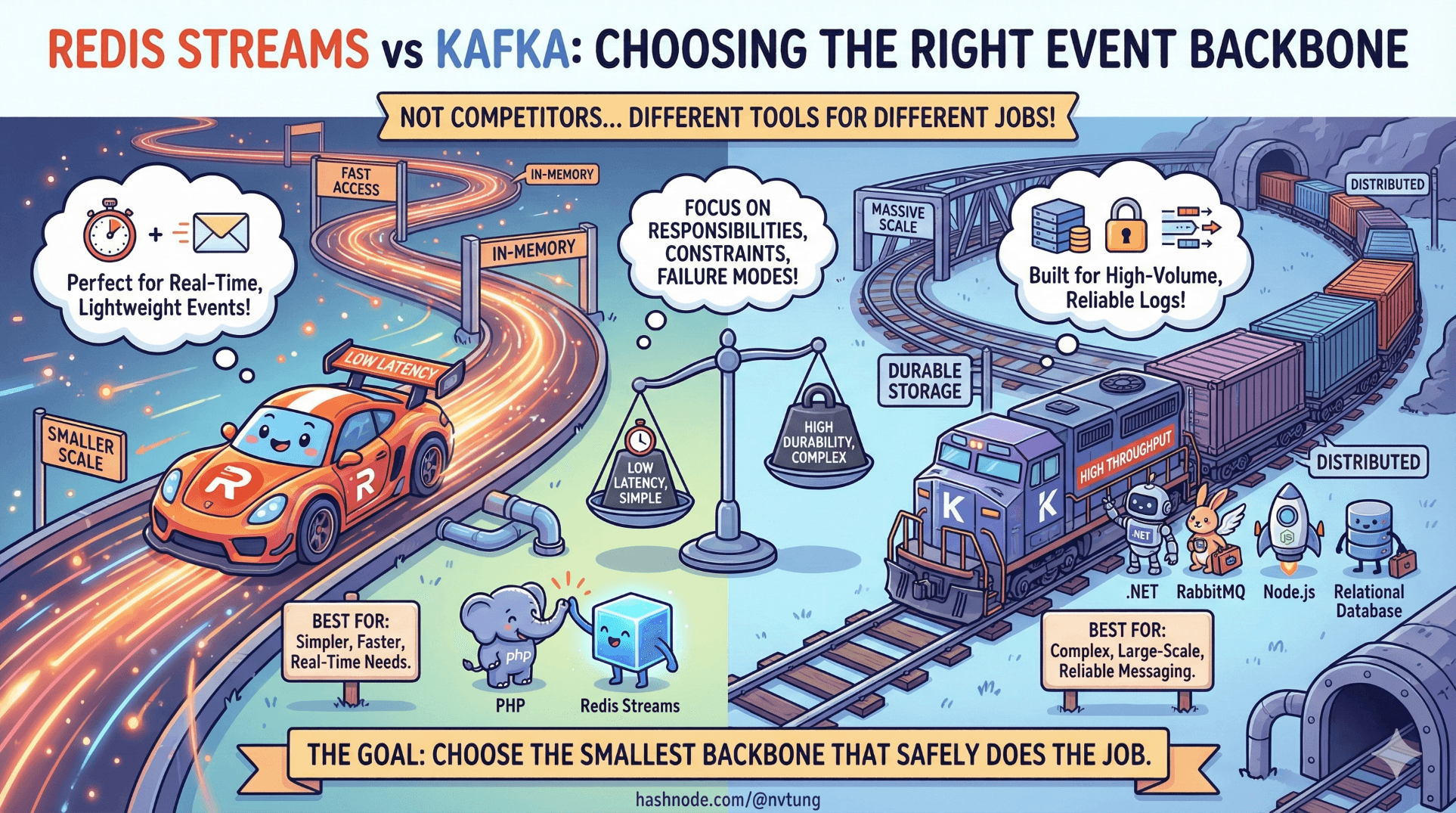
Choosing an event backbone is one of the most consequential decisions in an event-driven system—and also one of the most commonly misunderstood. Too often, the discussion starts with brand names instead of responsibilities, constraints, and failure modes.
Redis Streams and Kafka are not competitors in the abstract. They solve different problems, at different scales, with very different trade-offs. This article compares them using concrete examples and the same toolchain used throughout this series: PHP, Redis Streams, .NET, RabbitMQ, Node.js, and relational databases.
The goal is not to crown a winner.
The goal is to choose the smallest backbone that safely does the job.
Start With the Real Question (Not the Tool)
Before naming Redis or Kafka, ask this:
Do I need event propagation, or do I need event history?
That single question determines almost everything that follows.
Mental Models: Buffer vs Log
Redis Streams: A Time Buffer
Redis Streams behave like a durable, ordered buffer.
They are designed to:
Absorb bursts
Decouple producers and consumers
Allow consumer lag
Enable safe retries
They are not designed to be a long-term source of truth.
Think of Redis Streams as:
“Hold this until someone processes it.”

Kafka: A Distributed Event Log
Kafka behaves like a durable, replayable log.
It is designed to:
Retain events for days, weeks, or months
Allow consumers to replay from any offset
Treat events as data
Support stream processing
Think of Kafka as:
“This is the data.”
Architecture Implications (This Is the Real Cost)
Redis Streams Architecture
Producer → Redis Streams → Consumer Group → Processing → Ack
Simple
Few moving parts
Low operational overhead
Clear backpressure signals
Kafka Architecture
Producer → Kafka Broker Cluster → Topic → Partition → Consumer Group → Offset Commit
High throughput
Strong ordering per partition
Operationally heavy
Requires careful tuning and expertise
Kafka earns its complexity only when you use its strengths.
Producing Events: PHP Example
Redis Streams (PHP)
$redis->xAdd(
    'events',
    '*',
    [
        'event_type' => 'user.updated',
        'event_id' => uuid_create(UUID_TYPE_RANDOM),
        'occurred_at' => gmdate('c'),
        'data' => json_encode([
            'user_id' => 123,
            'display_name' => 'Alice'
        ])
    ]
);
One line
No schema registry
No partitions
No brokers to manage
This matters in legacy or core systems.
Kafka (Conceptual PHP via REST proxy)
$payload = [
  'records' => [[
    'value' => [
      'event_type' => 'user.updated',
      'event_id' => $uuid,
      'occurred_at' => gmdate('c'),
      'data' => [...]
    ]
  ]]
];

http_post('/topics/user-events', json_encode($payload));
Kafka production is never “just code”.
It’s code + infrastructure + governance.
Consumption Model: The Heart of the Difference
Redis Streams Consumer Group (.NET)
var entries = redis.StreamReadGroup(
    "user-group",
    "consumer-1",
    "events",
    ">"
);

foreach (var entry in entries)
{
    Process(entry);
    redis.StreamAcknowledge("events", "user-group", entry.Id);
}
Key properties:
At-least-once delivery
Explicit ack
Pending entries visible
Backpressure is obvious
Redis forces you to think operationally.
Kafka Consumer (.NET, simplified)
consumer.Subscribe("user-events");

while (true)
{
    var cr = consumer.Consume();
    Process(cr.Message.Value);
    consumer.Commit(cr);
}
Key properties:
Offset-based consumption
Replayable history
Ordering per partition
Commit semantics matter deeply
Kafka forces you to think in streams, not messages.
Backpressure: Where Systems Break First
Redis Streams
Backpressure shows up as:
Stream length growth
Pending entry growth
Consumer idle time
This is visible pressure.
Nothing crashes. Nothing blocks producers.
Latency increases instead of failure.

Kafka
Backpressure shows up as:
Consumer lag
Disk pressure
Broker I/O saturation
This is infrastructure pressure.
You must monitor and scale proactively.
Retention and Replay
This is Kafka’s strongest argument.
Kafka:
Replay from any offset
Rebuild state
Support event sourcing
Power stream processing
Redis Streams:
Replay is limited
Retention is bounded
History is not the product

If your system needs:
Auditing
Analytics
Historical reconstruction
Kafka starts to make sense.
If not, Kafka is usually overkill.
Operational Reality (The Part Blog Posts Skip)
Redis Streams Operational Profile
Single dependency (Redis)
Familiar tooling
Simple failure modes
Easy to reason about
Kafka Operational Profile
Broker clusters
ZooKeeper / KRaft
Capacity planning
On-call expertise
Schema governance

Kafka is powerful—but it is not casual infrastructure.
When Redis Streams Is the Right Choice
Redis Streams shines when:
Events are transient
You want buffering, not history
You already operate Redis
Latency matters
You value simplicity
The core system must stay protected

Redis is often the correct first backbone.
When Kafka Earns Its Complexity
Kafka earns its place when:
Events are data
Replay is mandatory
Throughput is extreme
Multiple consumers need independent history
Stream processing is required

Kafka is not “future-proofing” by default.
It’s a commitment.
A Common and Valid Hybrid Pattern
Many mature systems use both:
Redis Streams → buffer & protect core systems
Kafka → long-term log & analytics backbone
RabbitMQ → routing and fan-out
Each tool does one job well.

This is not redundancy.
This is separation of concerns.
The Most Dangerous Mistake
The most dangerous mistake is choosing Kafka because:
“We might need it later”
“It’s industry standard”
“It feels more scalable”
Premature Kafka adoption often:
Slows teams down
Hides architectural problems
Adds failure modes early
Consumes operational energy

Scale problems should earn their solutions.
Decision Cheat Sheet
| Requirement | Redis Streams | Kafka |
| Burst buffering | ✅ | ⚠️ |
| Backpressure visibility | ✅ | ⚠️ |
| Event replay | ⚠️ | ✅ |
| Operational simplicity | ✅ | ❌ |
| Event sourcing | ❌ | ✅ |
| Protecting legacy core | ✅ | ⚠️ |
Closing Thought
Event backbones are not trophies.
They are load-bearing structures.
Choose the one that:
Matches today’s reality
Fails predictably
Keeps teams moving
Leaves room to evolve
Redis Streams is not a “lightweight Kafka”.
Kafka is not a “better Redis”.
They are tools for different moments in a system’s life.
The best architecture is the one that lets you grow without fear, not the one that impresses on day one.