
When the Processor Becomes a Bottleneck
How central processors quietly turn into system bottlenecks
Series: Designing a Microservice-Friendly Datahub
In many event-driven architectures, there is a service that looks harmless on paper but carries more risk than any database or broker.
It’s the Processor.
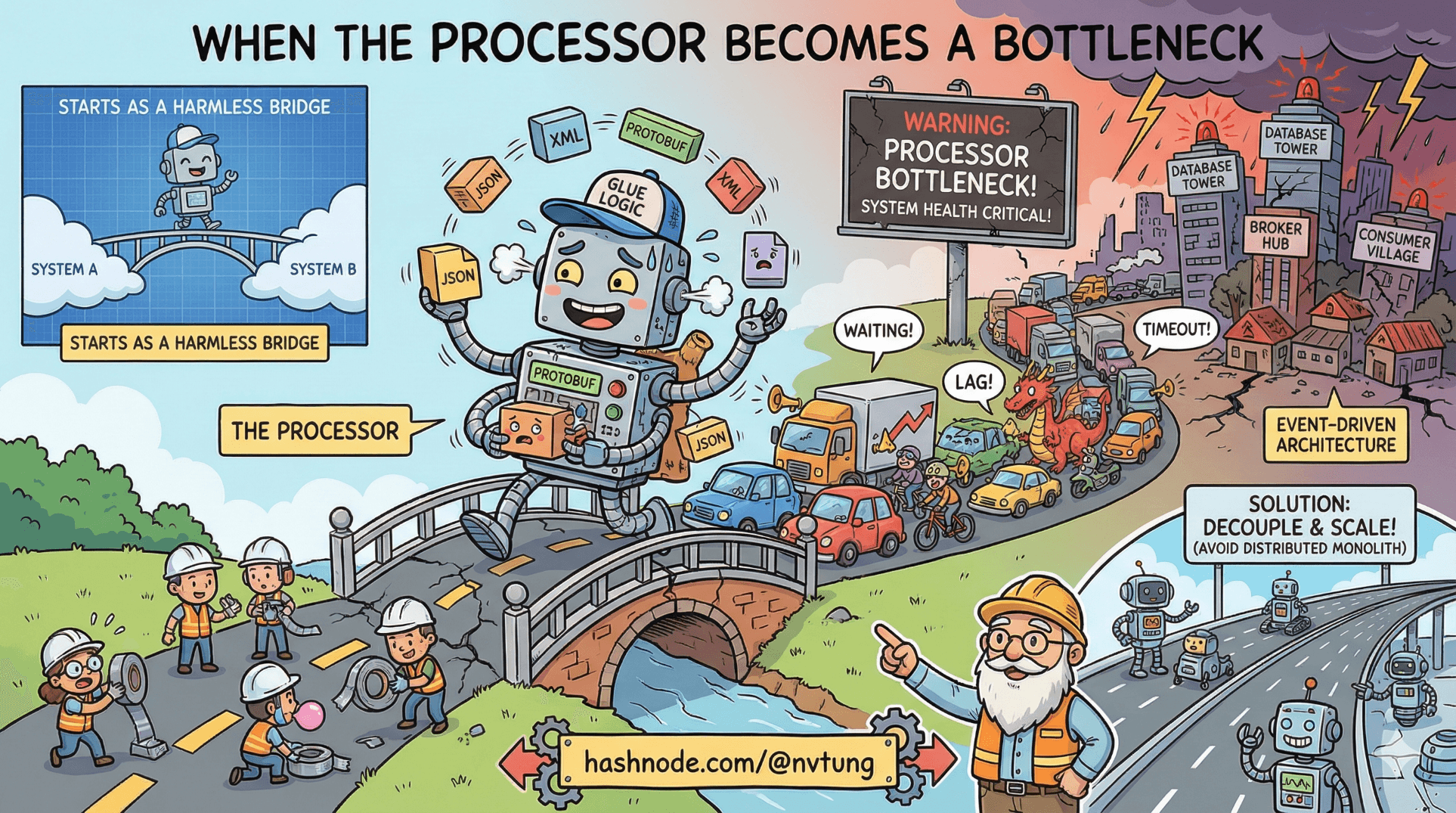
The Processor often starts life as a convenience: a bridge between systems, a translator between protocols, a place to put “just a bit of glue logic.” Over time, traffic grows, responsibilities accumulate, and suddenly the entire system’s health depends on whether this one service can keep up.
This article is about what happens when the Processor becomes a bottleneck—how to recognize it early, why it happens almost inevitably, and how to fix it without turning your architecture into a distributed monolith.
Why the Processor Is So Vulnerable
Processors sit at a dangerous intersection:
Upstream systems trust them to move data forward
Downstream systems depend on them for coordination
They often speak multiple protocols (Redis, RabbitMQ, HTTP)
They are expected to “just work” under load
That combination creates gravity.

Every shortcut, every “quick fix,” every cross-domain decision added here makes the Processor more central—and more fragile.
The First Signs of Trouble (Architectural Smells)
Processor bottlenecks rarely announce themselves clearly. They whisper first.
Common early signals:
Redis Streams pending entries growing steadily
RabbitMQ queues never draining
CPU usage uneven across processor instances
One handler dominating execution time
“Just scale it vertically” becoming the default response

At this stage, the problem is architecture, not performance tuning.
Smell #1: Too Many Responsibilities
The Processor often starts doing things it shouldn’t:
Applying business rules
Coordinating multi-step workflows
Making synchronous API calls to many services
Mutating state it doesn’t own
Example smell (pseudo-.NET):
if (event.Type == "order.created")
{
    ValidateOrder(event);
    ReserveInventory(event);
    ChargePayment(event);
    NotifyUser(event);
}
This looks efficient.
It is actually centralized orchestration disguised as event handling.
Smell #2: Synchronous Calls Inside Async Flows
Nothing kills throughput faster than blocking inside an event pipeline.
Example:
await httpClient.PostAsync("/inventory/reserve", payload);
await httpClient.PostAsync("/billing/charge", payload);
Now:
One slow service blocks the Processor
Retries amplify load
Backpressure moves upstream
Event lag explodes
Async architecture with sync behavior is worse than fully synchronous systems—it hides failure.
Smell #3: “One Processor to Rule Them All”
If one Processor handles:
Redis → RabbitMQ
RabbitMQ → API
External integrations
Batch jobs
Reconciliation logic
…then it is no longer a bridge.
It is a God service with a queue.
This is the most common failure mode.
Diagnosing the Bottleneck (Practically)
Redis Streams: Look at Pending Entries
XPENDING events processor-group
If:
Pending count keeps increasing
Oldest idle time grows
Messages are stuck to one consumer
Your Processor is not keeping up.
RabbitMQ: Look at Unacked Messages
Key indicators:
High unacked count
Low ack rate
Consumers “connected” but not progressing
This means processing—not routing—is the problem.
Why Scaling the Processor Often Fails
“Just add more instances” works only if:
Handlers are stateless
Work is evenly distributed
No shared locks or ordering constraints exist
External calls don’t dominate runtime
If any of these are false, horizontal scaling stalls quickly.

At that point, scaling exposes architectural coupling rather than fixing it.
The Right Fixes (In Order of Effectiveness)
1. Split by Responsibility, Not by Load
Instead of one Processor, use multiple narrow processors.
Bad split:
Processor A
Processor B (identical)
Good split:
Event Translator (Redis → RabbitMQ)
API Caller Processor
External Integration Processor
Each has:
One input
One responsibility
One scaling axis
2. Push Meaning to Consumers
The Processor should translate, not interpret.
Bad:
if (event.Status == "VIP")
{
    ApplySpecialRules();
}
Good:
Publish("user.updated", event);
Let consumers decide what “VIP” means.
3. Replace Sync Calls With Events
Instead of:
await httpClient.PostAsync("/billing/charge", payload);
Emit:
Publish("payment.requested", payload);
Now:
The Processor moves on
Billing scales independently
Failure is isolated
Retries are safe
4. Introduce Internal Queues
If some work is slow but unavoidable, isolate it.
Example:
Fast Processor → publishes to
slow.workSlow Worker consumes at its own pace
This turns blocking into buffering.
A Concrete Refactor Example
Before (Monolithic Processor)
Handle(event)
{
    Validate(event);
    CallApiA(event);
    CallApiB(event);
    PublishResult(event);
}
After (Decoupled)
Handle(event)
{
    Publish("event.received", event);
}
Then:
Worker A handles validation
Worker B handles API A
Worker C handles API B
Each scales independently
Latency increases slightly.
Throughput and reliability increase dramatically.
The Hard Truth: Processors Want to Become Monoliths
Processors accumulate logic because:
They feel “central”
They see all events
They’re convenient to modify
They’re already deployed
Resisting that pull requires discipline, not tools.

A good Processor is boring.
A clever Processor is a future outage.
When a Processor Is Still the Right Tool
Processors are valuable when they:
Translate protocols
Normalize schemas
Enforce contracts
Handle retries and DLQs
Absorb infrastructure complexity

They are dangerous when they:
Decide business outcomes
Coordinate workflows
Own domain rules
Become required for every feature
A Simple Litmus Test
Ask this question:
“If this Processor is down, can the rest of the system still make progress?”
If the answer is “no,” the Processor is too important.
Closing Thought
Processors don’t usually fail because they’re slow.
They fail because they’re asked to be too smart.
Event-driven systems scale by distributing meaning, not centralizing it.
When the Processor becomes a bottleneck, it’s not telling you to optimize—it’s telling you to give responsibility back to the edges.
That’s not a performance fix.
That’s architectural maturity.