
Introduction to Passwordless: Modern Authentication Patterns for PWAs
From passwords to passkeys: designing real authentication systems for Progressive Web Apps
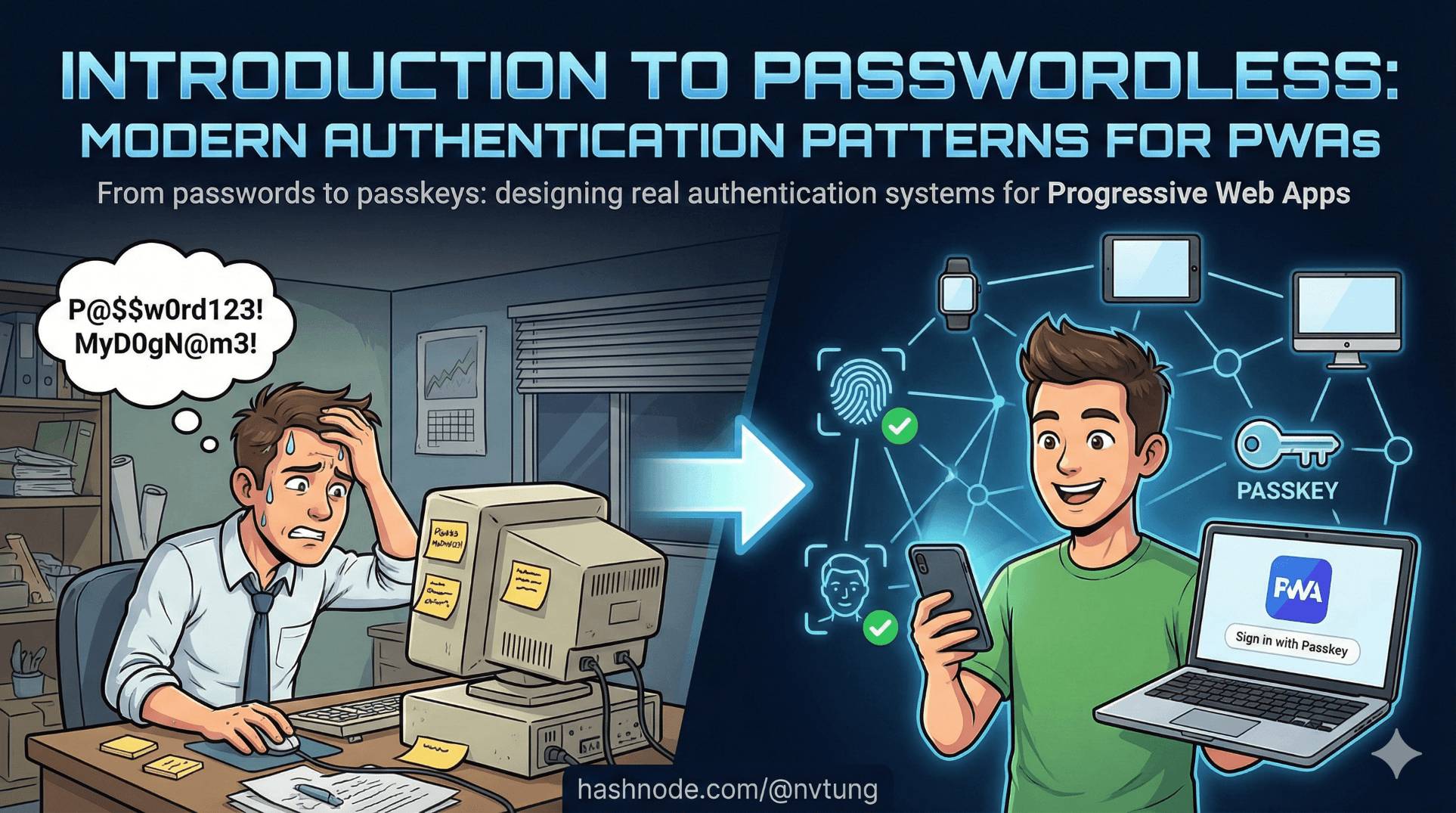
Passwords were never designed to scale with the modern web — and Progressive Web Apps inherit all of their weaknesses while adding new constraints of their own.
This series explores how modern PWAs can move beyond passwords using FIDO-powered biometrics (WebAuthn), without falling into the trap of treating passwordless as a silver bullet. Starting from foundational concepts and best practices, it builds toward a real-world implementation I’ve created and improved from a POC that combines passwordless-first authentication with OpenID Connect for fallback and recovery.
The goal is not to explain APIs in isolation, but to show how authentication systems are actually designed, operated, and evolved in practice.
Series structure
Part I — Foundations
Goal: Align readers on what authentication really is before touching APIs.
Article 1 — Authentication is Not Login
Identity vs authentication vs authorization
Why passwords became a liability
Threat models relevant to PWAs (phishing, replay, credential stuffing)
Why “just add biometrics” is a misunderstanding
Article 2 — What “Passwordless” Actually Means
Passwordless vs MFA vs passwordless-first
Knowledge, possession, inherence factors (plain-language explanation)
Where WebAuthn fits
Common myths (passwordless = no backend, passwordless = device lock-in)
Part II — Standards & building blocks
Goal: Introduce the standards without drowning readers in specs.
Article 3 — WebAuthn & FIDO2, Explained Without the Spec
What problems WebAuthn solves
Public-key credentials, challenges, assertions
Platform vs roaming authenticators
User verification vs user presence
Why WebAuthn is phishing-resistant by design
Article 4 — OpenID Connect as the Glue
What OIDC actually provides (and what it doesn’t)
Why PWAs still need federated identity
Authorization Code + PKCE (conceptual, not tutorial-heavy)
Using IdPs for bootstrap, recovery, and portability
Part III — Architecture & best practices
Goal: Show how real systems combine these pieces.
Article 5 — Designing a Passwordless-First PWA Architecture
Decision points: when to attempt WebAuthn vs fallback
Server responsibilities (credential storage, challenges, counters)
Session management in PWAs
Secure token handling (cookies vs storage)
Why offline PWAs complicate auth more than expected
Article 6 — UX and Failure Are Part of the Security Model
Retry flows, lockouts, and graceful degradation
Multi-device reality
Lost device scenarios
Why fallback is not a weakness but a requirement
Part IV — My real implementation
Goal: Ground theory in a real, working flow.
Article 7 — A Real Passwordless PWA Flow (Architecture Walkthrough)
Walk through the full authentication flow I designed
Explain the decision tree (passwordless enabled vs not)
Role of the backend vs browser vs authenticator
Why each branch exists
Article 8 — Implementing WebAuthn in Practice
Tooling used (e.g. WebAuthn server libs, client helpers)
Data models (credential ID, public key, counters)
Common implementation pitfalls
What surprised me during implementation
Article 9 — Integrating OIDC (Feide) as Fallback and Recovery
Why Feide was chosen
How OIDC fits without undermining passwordless
Security boundaries between IdP and my system
Account linking considerations
Part V — Reflection & lessons learned
Goal: Help readers avoid future mistakes.
Article 10 — What Worked, What Didn’t, What I’d Change
Trade-offs I accepted knowingly
Things that looked good on paper but failed in reality
Operational lessons (support, monitoring, edge cases)
Optional supplemental articles
Why Passwordless Alone Is Not an Identity Strategy
Explain why fallback (OIDC, IdPs, recovery flows) is a design requirement, not a compromise
Connect passwordless to enrollment, recovery, device loss, and federation
Show architectural maturity without diving into APIs
How Browser UX Shapes Security More Than Cryptography
How browser and OS UX decisions constrain authentication design
Why the same WebAuthn flow feels different in Chrome, Safari, and mobile OSes
How retries, error messages, and permission dialogs affect security outcomes
Why good UX prevents insecure workarounds more effectively than stronger algorithms
☰ Series Navigation
Core Series
→ Introduction
Article 7 — A Real Passwordless PWA Flow (Architecture Walkthrough)
Article 9 — Integrating OIDC (Feide) as Fallback and Recovery