
Cron in Frameworks: From Theory to Convention
How modern frameworks tame cron with structure, conventions, and guardrails
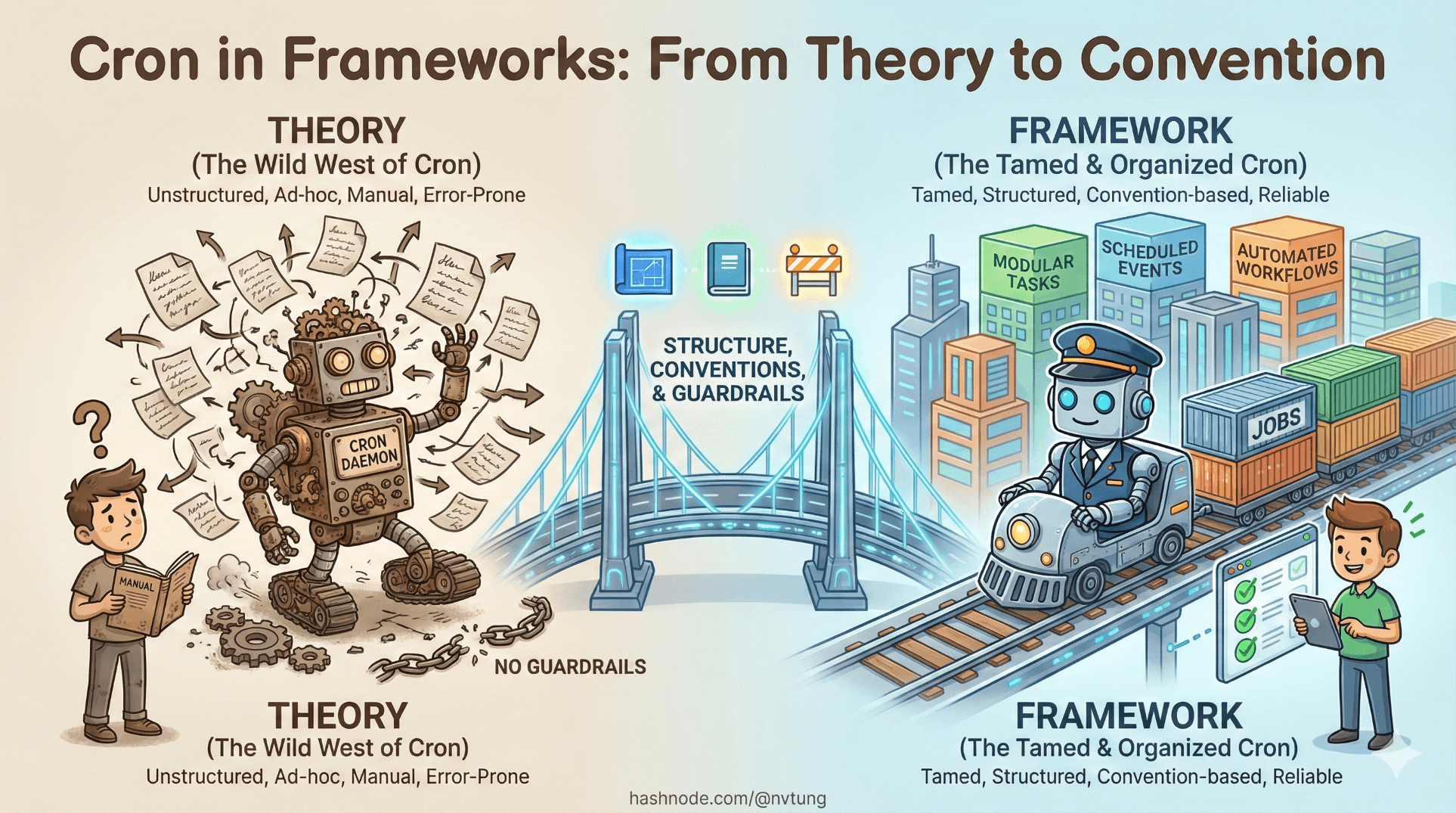
By the time a system grows beyond a single script on a single server, raw cron starts to feel… sharp. Powerful, yes—but easy to misuse. This is the moment frameworks step in, not to replace cron, but to put guardrails around it.
Modern frameworks don’t expose cron as a free-form text file you casually edit. Instead, they funnel time-based execution through conventions: commands, schedulers, queues, and configuration layers. This isn’t abstraction for abstraction’s sake. It’s a response to decades of hard-won lessons about how cron fails in real applications.
Understanding what frameworks do with cron—and what they don’t—is essential if you want to use them well rather than fight them.
Why Frameworks Don’t Expose Raw Cron Logic
Frameworks are opinionated by necessity. They exist to reduce the surface area where mistakes can happen repeatedly.
Raw cron has several properties frameworks actively avoid:
It is global and system-wide
It is loosely coupled to application code
It has no inherent structure or validation
It encourages one-off, undocumented decisions
From a framework’s perspective, raw cron is too powerful and too unstructured. Letting every developer drop arbitrary commands into a system crontab guarantees inconsistency, duplication, and brittle behavior.

Instead, frameworks treat cron as an external trigger. They accept that cron exists, but they insist that:
Scheduling intent lives inside the application
Execution logic is versioned with code
Behavior is testable and repeatable
Operational concerns are centralized
In other words, frameworks pull cron upward into the application layer, even if the final trigger still comes from the OS.
The Common Abstractions Frameworks Use
Across ecosystems, a small set of abstractions appears again and again. The names differ, but the ideas are remarkably consistent.

Console Commands
The first abstraction is the command-line interface.
Frameworks define a formal way to declare commands:
Named
Parameterized
Version-controlled
Runnable by humans and automation alike
Cron is then pointed at these commands, not at ad-hoc scripts. This creates a clean seam: cron triggers commands, commands execute application logic.
This separation matters. It means the same logic can be:
Run manually for debugging
Tested in isolation
Logged and monitored consistently
Cron becomes a caller, not a container for logic.
Scheduled Tasks
Many frameworks go a step further and introduce a scheduler layer. Instead of writing time expressions in crontab, developers declare schedules in code.
This flips the relationship:
Cron runs once per minute (or similar)
The framework decides which tasks should run now
The benefit is centralization. All schedules live in one place, are reviewable, and can share behavior like locking, environment checks, or feature flags.
Cron becomes a heartbeat. The framework becomes the brain.
Job Queues
At scale, frameworks increasingly assume that scheduled tasks should not do heavy work directly. Instead, they enqueue jobs.
This formalizes delegation:
Scheduled task decides what should happen
Queue decides when and how it happens
Workers decide how much can run concurrently
By making queues a first-class concept, frameworks nudge developers away from the “cron does everything” anti-pattern and toward architectures that tolerate failure and scale horizontally.
A Conceptual Comparison: Yii, Laravel, Symfony
Different frameworks express these ideas differently, but the philosophical direction is shared.
Yii
Yii leans heavily on explicit console commands and a clear separation between scheduling and execution. Cron typically triggers a small set of entry points, and the framework handles dispatching work internally. The emphasis is on clarity and explicitness.
Laravel
Laravel makes scheduling highly expressive and developer-friendly. Schedules are defined in code, queues are deeply integrated, and cron is reduced to a simple, repeatable trigger. The framework strongly encourages delegation and observability through conventions.
Symfony
Symfony provides building blocks rather than a single prescribed flow. Console commands, schedulers, and messaging components can be composed in different ways. The framework offers discipline without forcing a single pattern.

What differs is ergonomics and defaults—not intent. All three frameworks aim to structure cron usage, not eliminate it.
Where Frameworks Help
Frameworks excel at:
Making scheduling explicit and reviewable
Reducing duplication and inconsistency
Encouraging delegation to queues
Providing hooks for logging and monitoring
Making time-based behavior testable

They encode best practices that would otherwise have to be rediscovered by each team.
Most importantly, they shift cron from an operational afterthought to an architectural concern.
Where Frameworks Don’t Help
Frameworks do not change cron’s fundamental nature.
They do not:
Guarantee execution during downtime
Solve clock drift
Prevent overlapping jobs by magic
Replace the need for idempotency
Automatically make jobs observable

Framework abstractions can hide complexity, but they cannot remove it. If you don’t understand what cron is doing underneath, framework sugar can lull you into false confidence.
The system clock still rules. The OS still schedules. Failures still happen in the gaps between intention and execution.
The Key Insight: Discipline, Not Replacement
The most important thing frameworks teach—often implicitly—is restraint.
They don’t pretend cron is smarter than it is. Instead, they discipline how it’s used:
By limiting where scheduling decisions live
By forcing execution through known entry points
By encouraging separation between intent and work

When developers bypass these conventions and “just add a crontab entry,” they step outside the framework’s safety net. Sometimes that’s necessary. Often it’s a warning sign.
Understanding the framework’s cron model is not about memorizing APIs. It’s about aligning with the architectural assumptions the framework is built on.
Once you do, cron stops feeling like a hack bolted onto your application—and starts feeling like a well-understood part of its nervous system.
And that understanding is what keeps systems predictable long after they stop being small.
☰ Series Navigation
Core Series
Part 2: Anatomy of a Cron Job
→ Part 4: Cron in Frameworks: From Theory to Convention
Part 5: HumHub & Yii: Design Intent Behind the Cron Architecture