
Introduction to Understanding Cron from First Principles to Production
Why cron still matters, how time-based jobs really work, and where they fit in modern web architecture
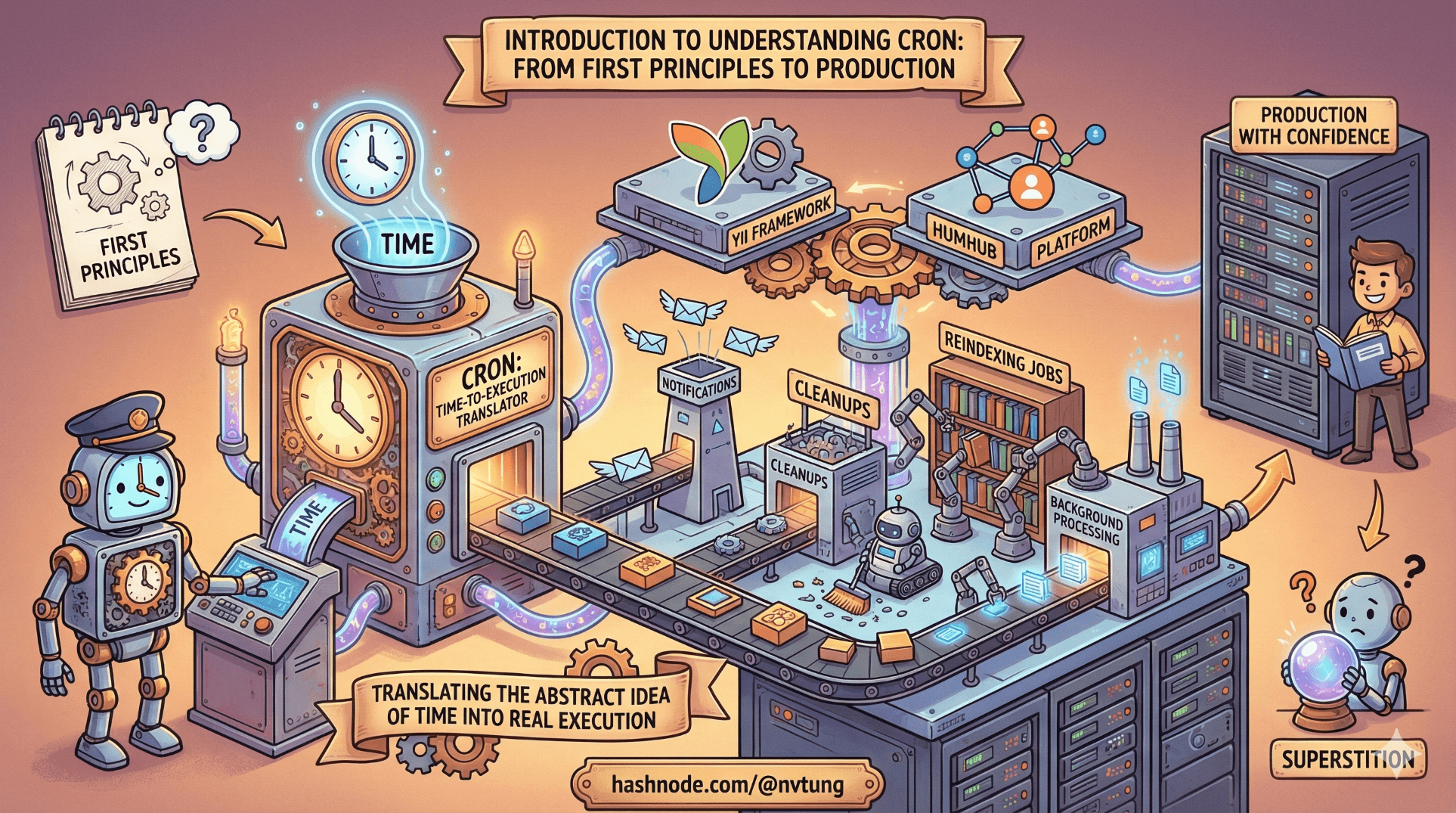
Cron is one of the oldest pieces of software still quietly shaping modern systems. It doesn’t announce itself, it doesn’t demand attention, and when it works, nobody notices. Yet behind notifications, cleanups, digests, reindexing jobs, and background processing, cron often sits at the center, translating the abstract idea of time into real execution. This series is about understanding that translation—how scheduled tasks actually run, how frameworks like Yii and platforms like HumHub build on top of cron, and what happens when theory meets production constraints. By moving from general concepts to a real implementation, the goal isn’t to glorify cron or replace it, but to understand its role clearly enough to use it with confidence instead of superstition.
Disclaimer
The system implementation discussed in this series was originally designed and deployed in 2021, reflecting the tools, constraints, and best practices available at that time. While the architectural principles remain relevant, some technical details may differ from current or evolving approaches.
Details shared in this series are intentionally generalized and anonymized to comply with non-disclosure agreements (NDA). No proprietary code, confidential infrastructure details, or sensitive operational data are disclosed. The examples and configurations shown are representative rather than exact replicas of production systems.
🌐 Series Vision
Goal:
Help readers understand how cron-based systems actually work in production—starting from fundamentals, moving through modern best practices, and ending with a concrete Yii/HumHub implementation that exposes real-world tradeoffs.
Target readers:
PHP / Yii / HumHub developers
Backend engineers who “use cron” but don’t fully trust it
Devs transitioning from small apps to production systems
📚 Article Series Guideline
Part 1 — Cron: The Invisible Operating System
Scope: General, language-agnostic
Purpose:
Reframe cron not as “a Linux thing” but as a coordination mechanism between time and software.
Core ideas to cover:
What cron is (and what it is not)
Why cron still exists despite queues, clouds, and serverless
Mental model: time-triggered execution vs event-driven execution
Cron vs user-driven execution
Common myths:
“Cron is unreliable”
“Cron doesn’t scale”
“Cron is outdated”
Outcome for reader:
They stop seeing cron as magic text in /etc/crontab and start seeing it as a system primitive.
Part 2 — Anatomy of a Cron Job
Scope: Still general, but more technical
Purpose:
Teach how cron jobs behave at runtime, not just syntactically.
Core ideas:
Crontab syntax demystified (with real timing diagrams)
Environment differences (PATH, permissions, locales)
Output handling (stdout vs stderr)
Idempotency and why it matters
What happens when:
A job overlaps
A job crashes
A job runs longer than expected
Architecture concepts introduced:
Fire-and-forget execution
Stateless vs state-aware cron jobs
Locking strategies (file locks, DB locks)
Outcome:
Readers learn why “it works on my machine” fails at 2 AM.
Part 3 — Cron at Scale: Patterns and Anti-Patterns
Scope: Cross-framework, production-oriented
Purpose:
Show how cron evolves as systems grow.
Patterns to cover:
Cron as a scheduler, not a worker
Delegation to:
Job queues
Message brokers
Task runners
Fan-out vs fan-in job models
High-frequency vs low-frequency jobs
Anti-patterns:
Doing heavy work directly in cron
Silent failure (
>/dev/nulleverywhere)Multiple servers running the same cron
No observability
Tools to mention conceptually:
Cron + queue systems
Supervisor / systemd timers
Monitoring & alerting hooks
Outcome:
Readers learn when cron should step back and let other systems do the heavy lifting.
Part 4 — Cron in Frameworks: From Theory to Convention
Scope: Framework-oriented overview
Purpose:
Explain how modern frameworks wrap cron into something safer and more structured.
Topics:
Why frameworks don’t expose raw cron logic
Common abstractions:
Console commands
Scheduled tasks
Job queues
Comparison at a conceptual level:
Yii
Laravel
Symfony
Where frameworks help—and where they don’t
Key insight:
Frameworks don’t replace cron; they discipline it.
Outcome:
Readers understand why “just add a crontab entry” is rarely enough in real apps.
Part 5 — HumHub & Yii: Design Intent Behind the Cron Architecture
Scope: Specific to Yii + HumHub, but still explanatory
Purpose:
Explain why HumHub chose its cron model, not just how.
Topics:
Yii console architecture
cron/runvsqueue/runAsynchronous vs interval jobs in HumHub
Design goals:
Responsiveness
Decoupling
Predictability
Tradeoffs of running both every minute
Outcome:
Readers gain empathy for the framework’s design choices instead of cargo-culting them.
Part 6 — A Real Production Setup: What I Actually Built
Scope: My implementation
Purpose:
Ground the theory in a real system with constraints.
Content:
Infrastructure context (envs, uptime windows)
The exact crontab setup
Why output is suppressed
Why one-minute granularity was chosen
How async and interval jobs coexist
Known limitations (e.g., nightly downtime)
Tone:
Calm, honest, non-marketing.
Outcome:
Readers see a credible, imperfect real-world setup they can learn from.
Part 7 — Failure Modes, Tradeoffs, and Lessons Learned
Scope: Reflective, high value
Purpose:
Turn experience into transferable wisdom.
Topics:
What breaks first under load
What breaks silently
What surprised you
What you’d change with:
More traffic
More servers
More budget
Why some “best practices” were consciously ignored
Outcome:
Readers learn how to think, not just what to copy.
Part 8 — The Evolution Path: From Cron to Orchestration
Scope: Forward-looking
Purpose:
Place cron in the broader ecosystem without declaring it obsolete.
Topics:
When cron is enough
When to add:
Persistent workers
Distributed queues
Cloud schedulers
Migration strategies
Hybrid models (cron + event-driven)
Outcome:
Readers leave knowing cron’s proper place in modern architecture.
Optional Extras
⏳ Cron Lies: When Scheduled Jobs Don’t Run (and Nobody Notices)
Focus:
Silent failures
Downtime windows
Clock drift
Disabled cron services
Why “every minute” doesn’t mean what people think
Why it’s valuable:
Teaches defensive thinking
Extremely relatable
Pairs beautifully with your dev/UAT downtime case
🔁 Idempotency: The Most Important Word in Cron You’re Probably Ignoring
Focus:
What idempotency actually means
Why cron jobs must be idempotent
Real examples of non-idempotent disasters
Yii/HumHub-specific strategies
Why it fits:
Deep concept
Rarely explained well
Immediately practical
⚖️ Cron vs Queue vs Event: Choosing the Right Trigger
Focus:
Time-triggered vs event-driven vs user-driven
Decision matrix
Hybrid patterns
Why misuse causes architectural debt
Why it’s strong:
Helps readers design, not just implement
Broadens appeal beyond PHP
☰ Series Navigation
Core Series
→ Introduction
Part 2: Anatomy of a Cron Job
Part 5: HumHub & Yii: Design Intent Behind the Cron Architecture