
Cron: The Invisible Operating System
Why cron is a system primitive—and why time-based execution still matters in modern software
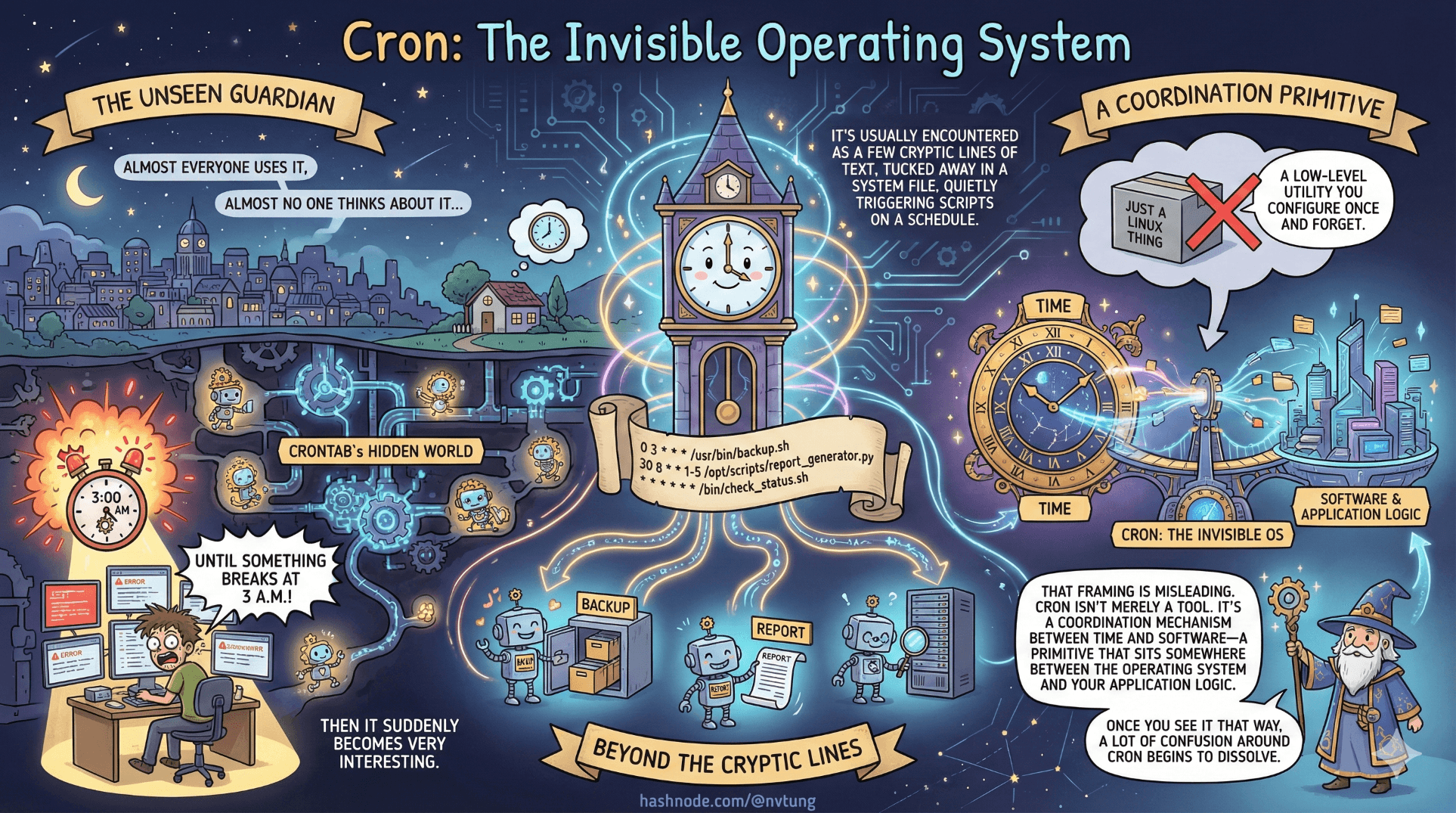
Cron is one of those technologies that almost everyone uses and almost no one thinks about—until something breaks at 3 a.m. Then it suddenly becomes very interesting. It’s usually encountered as a few cryptic lines of text, tucked away in a system file, quietly triggering scripts on a schedule. Because of that, cron is often dismissed as “just a Linux thing,” a low-level utility you configure once and forget.
That framing is misleading. Cron isn’t merely a tool. It’s a coordination mechanism between time and software—a primitive that sits somewhere between the operating system and your application logic. Once you see it that way, a lot of confusion around cron begins to dissolve.
This article is about building that mental model.
What Cron Is — and What It Is Not
At its core, cron does exactly one thing: it translates time into execution.
You tell the system when something should happen, and cron ensures that a command is invoked at—or as close as possible to—that moment. That’s it. Cron does not know what your program does. It does not know whether the task succeeded. It does not manage retries, rollbacks, or business logic. It simply wakes up at prescribed times and says, “Run this.”
That simplicity is both its strength and its source of misunderstanding.
Cron is not:
A job queue
A workflow engine
A monitoring system
A reliability guarantee

Cron does not promise that your job will finish, or even that it will run under perfect conditions. It promises only that the system will attempt execution when the clock matches your schedule.
Seen this way, cron is closer to an interrupt or a timer than to an application framework. It’s a system primitive: blunt, predictable, and intentionally limited.
Why Cron Still Exists in a World of Queues, Clouds, and Serverless
Given modern alternatives—message queues, event buses, cloud schedulers, serverless functions—it’s reasonable to ask why cron hasn’t faded into obsolescence.
The answer is deceptively simple: time still matters, and not everything is driven by events.
Queues and event-driven systems react to something happening. Cron reacts to nothing happening except the passage of time. That distinction is fundamental.
There are entire classes of problems that exist because time passed:
Daily reports
Periodic cleanup
Expiring data
Scheduled notifications
Reconciliation tasks
Audits and compliance checks

You can build elaborate systems to simulate time-based triggers using queues or events, but at some point, something still needs to say: “It is now midnight. Do the thing.” Cron occupies that role cleanly and cheaply.
Cloud platforms haven’t replaced cron; they’ve rebranded it. “Cloud Scheduler,” “EventBridge rules,” “scheduled functions”—these are cron’s descendants, not its enemies. They carry the same core idea: bind execution to time, not to user behavior or system events.
Cron persists because the abstraction it provides is minimal and universal. It doesn’t care about programming languages, frameworks, or deployment models. As long as there is a clock and a process to run, cron makes sense.
A Useful Mental Model: Time-Triggered vs Event-Driven Execution
Most modern applications are event-driven. A user clicks a button. An API request arrives. A message appears on a queue. Code runs because something happened.
Cron represents the other axis: time-triggered execution.
This distinction is crucial:
Event-driven systems react to external stimuli. They scale with activity.
Time-triggered systems act independently of activity. They scale with schedules.
Neither is better. They solve different problems.
Time-triggered execution is particularly valuable when:
Work must happen even if no users are active
The system must periodically reassert consistency
External systems expect data at fixed intervals
You want predictability over immediacy

Once you adopt this mental model, cron stops looking primitive and starts looking foundational. It is the simplest possible time-triggered execution engine.
Cron vs User-Driven Execution
Another way to understand cron is by contrasting it with user-driven execution.
User-driven execution is reactive and contextual. It depends on:
Who triggered the action
What input they provided
What the system state looked like at that moment
Cron-driven execution is indifferent. It runs whether users are awake or asleep, whether traffic is high or nonexistent. That indifference is a feature, not a flaw.
Because cron is decoupled from user intent, it is ideal for:
Maintenance
Housekeeping
Enforcement of invariants
Long-running or resource-intensive tasks

This separation is healthy. It keeps user-facing interactions fast and predictable while pushing non-interactive work into a different execution model entirely.
In effect, cron lets your system take care of itself.
Common Myths About Cron
“Cron Is Unreliable”
Cron is often blamed when jobs fail, but most failures attributed to cron are actually failures of assumptions.
Cron will:
Run a command at a scheduled time if the system is up
Run it with a minimal, non-interactive environment
Cron will not:
Guarantee network availability
Ensure dependencies are present
Retry failed logic
Protect you from race conditions

When people say cron is unreliable, they usually mean “I expected cron to do more than it promised.” Cron is brutally honest about its responsibilities. Reliability emerges from how you design the job around it, not from cron itself.
“Cron Doesn’t Scale”
Cron scales exactly as far as its responsibility goes.
A single cron daemon triggering commands scales poorly if you ask it to do heavy computation, coordinate distributed work, or manage concurrency. But that’s not cron’s job. Cron is a scheduler, not a worker pool.
In scalable systems, cron often sits at the top of the funnel:
It triggers a lightweight command
That command delegates work to queues, workers, or services

In this role, cron scales just fine, because it does very little. The mistake is expecting it to scale in dimensions it was never designed to occupy.
“Cron Is Outdated”
Cron feels old because it is old—and because it solved a fundamental problem early and solved it well.
The passage of time hasn’t made the problem go away. Systems still need periodic action. Data still expires. Reports still need to be generated. Cron remains relevant for the same reason filesystems remain relevant: the abstraction is timeless.

What has changed is how cron is used. Modern systems wrap it, constrain it, and integrate it with higher-level orchestration. But underneath, the idea remains the same.
Cron as a System Primitive
If there’s one takeaway from this article, it’s this: cron is not application logic; it is infrastructure.
Treating cron as “just a Linux feature” leads to fragile systems and superstition-driven configuration. Treating it as a system primitive leads to clarity:
Cron handles when
Your application handles what and how
Other systems handle scale, retries, and observability

Once you see cron this way, the cryptic lines in a crontab stop looking like magic spells and start looking like a low-level contract between time and software.
That shift in perspective is the foundation for everything else in this series.
☰ Series Navigation
Core Series
→ Part 1: Cron: The Invisible Operating System
Part 2: Anatomy of a Cron Job
Part 5: HumHub & Yii: Design Intent Behind the Cron Architecture