
HumHub & Yii: Design Intent Behind the Cron Architecture
Why HumHub schedules the way it does—and what its cron model is really optimizing for
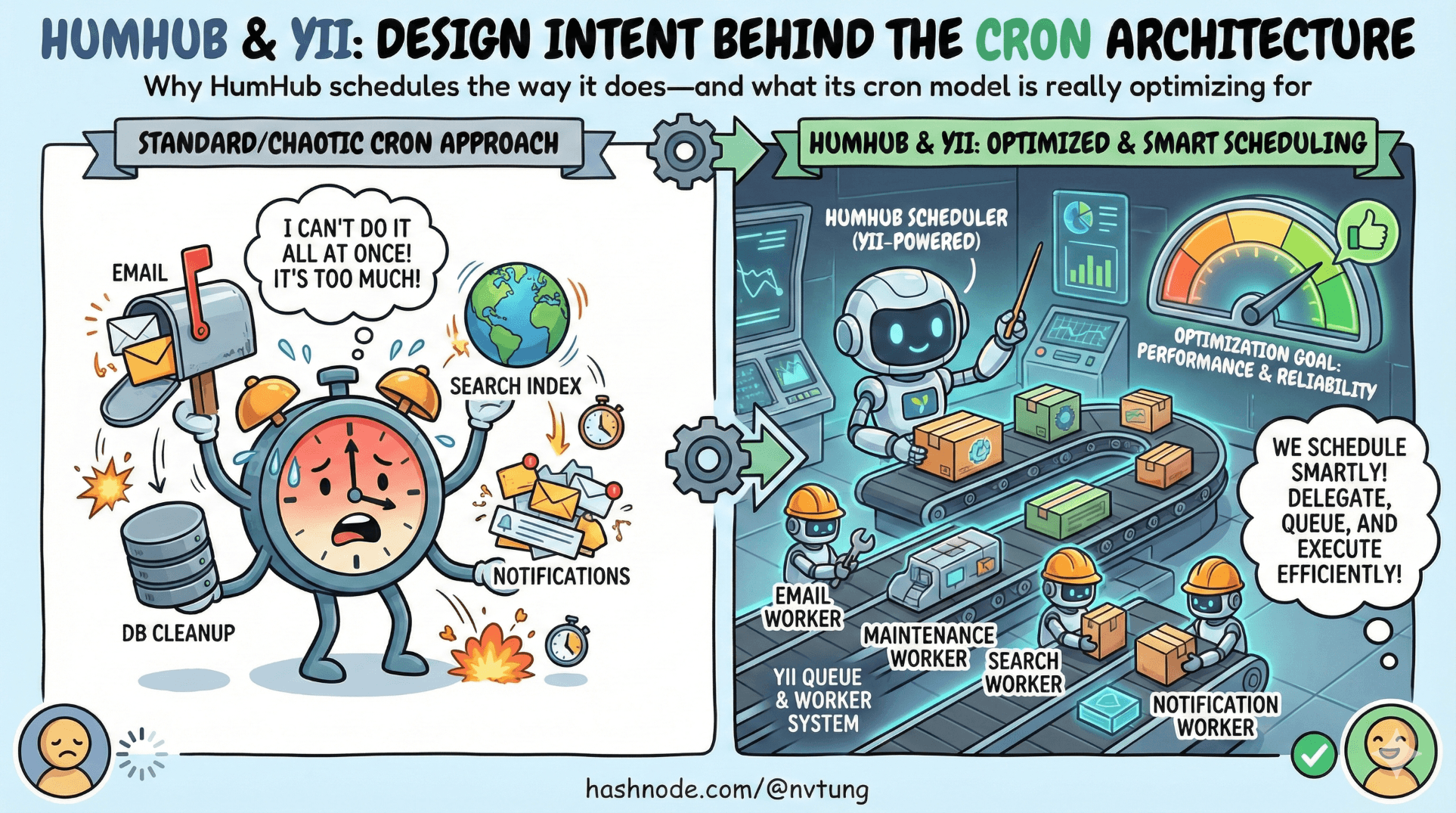
At first glance, HumHub’s cron setup looks almost suspiciously simple. Two commands. Run every minute. No fancy schedules. No visible orchestration logic.
If you approach it expecting a clever optimization, you might be tempted to “improve” it. Split the schedules. Slow some jobs down. Speed others up. Or worse: bypass the framework and add raw crontab entries directly.
That instinct usually comes from not understanding why this design exists.
This article is about intent. Not just how HumHub wires cron into Yii, but why it chose this particular shape, and what tradeoffs it consciously accepts.
Yii’s Console Architecture: The Foundation
HumHub is built on Yii, and Yii’s console architecture is the bedrock everything else rests on.
In Yii, console commands are first-class citizens. They live alongside web controllers, share configuration, and execute application logic in a controlled, testable way.
A minimal Yii console command looks like this:
namespace app\commands;

use yii\console\Controller;

class ExampleController extends Controller
{
    public function actionRun()
    {
        echo "Hello from cron\n";
    }
}
This command can be executed as:
php yii example/run
Key properties of this model:
Commands are versioned with the application
They share the same DI container and config
They can be invoked by humans, cron, or automation
They are explicit entry points, not hidden scripts
HumHub builds its entire scheduling model on top of this structure.
HumHub’s Two Entry Points: cron/run and queue/run
HumHub introduces two canonical console commands:
php yii cron/run
php yii queue/run
These are not arbitrary names. They encode a strict separation of responsibility.
cron/runanswers: “Which scheduled tasks are due right now?”queue/runanswers: “What asynchronous work is waiting to be processed?”
Both are typically executed every minute.
This is not redundancy. It is orthogonality.
Interval Jobs: Time-Decided, Framework-Controlled
Interval jobs in HumHub are handled by cron/run.
Instead of defining dozens of crontab entries, HumHub centralizes scheduling logic inside the application. Cron triggers the framework once per minute, and the framework decides what is due.
Conceptually, it looks like this:
* * * * * php yii cron/run
Inside the framework, jobs declare their own schedules:
public function getSchedule()
{
    return [
        'hourly',
        'daily',
    ];
}
At runtime:
cron/runchecks the current timeIt evaluates which jobs are due
It executes or dispatches them accordingly
This design achieves something subtle but powerful: time-based intent lives in code, not in the OS.
You can review it. Test it. Version it. Reason about it.
Cron itself becomes a dumb heartbeat.
Asynchronous Jobs: Event-Decided, Queue-Controlled
Asynchronous jobs are handled by queue/run.
These jobs are not tied to wall-clock schedules. They are triggered by events: user actions, system changes, or background processes.
A simplified example of pushing a job:
Yii::$app->queue->push(new SendNotificationJob([
    'userId' => $userId,
]));
And the corresponding worker loop:
* * * * * php yii queue/run
The queue:
Buffers work
Decouples execution from request time
Allows retries, delays, and prioritization
This is where responsiveness comes from. User-facing actions enqueue work instead of performing it inline.
Why Run Both Every Minute?
This is the design choice that raises the most eyebrows.
Why not:
Run
queue/runcontinuously?Run
cron/runless frequently?Separate them across servers?
The answer is predictability.

Running both every minute creates a stable, uniform execution rhythm:
One-minute latency is the worst case
No long-lived workers to manage
No hidden background processes
Easy to reason about and operate
This is not about theoretical efficiency. It’s about operational calm.
HumHub optimizes for environments where:
You may not control process supervisors
You may not have persistent workers
Simplicity matters more than micro-optimizations
The framework chooses boring reliability over cleverness.
Responsiveness by Design
Responsiveness is achieved not by speed, but by deferral.
User requests do not:
Send emails
Rebuild indexes
Notify followers
They enqueue jobs.

The queue absorbs variability. The cron-driven worker drains it predictably.
This keeps the web layer fast and the background layer controlled.
Decoupling: Time vs Work
HumHub’s architecture cleanly separates:
When something should happen (cron)
What should happen (jobs)
How it happens (queue workers)
This decoupling allows each concern to evolve independently.

You can:
Change schedules without touching infrastructure
Change execution logic without changing cron
Change worker behavior without touching user flows
That flexibility is intentional.
Predictability Over Precision
Running every minute is not “wasteful” in this model. It is predictable.
Predictability means:
Easy mental models
Fewer edge cases
Fewer special rules
Fewer “except when…” clauses

HumHub accepts that some jobs might wait up to 60 seconds. In return, it gets a system that behaves the same way at 2 PM and 2 AM.
That tradeoff is explicit.
The Tradeoffs (Because There Are Always Tradeoffs)
This design is not perfect.
Costs include:
Slight latency for async work
Potential overlap if jobs are slow
Increased importance of idempotency
Reliance on external cron availability

HumHub does not hide these costs. It assumes developers understand them—or will learn them.
This is where empathy matters. The framework is not trying to be the most optimized system possible. It is trying to be predictable across many hosting environments.
What Happens When You Cargo-Cult This Design
Problems arise when teams copy the surface without the intent.
Running cron/run every minute:
Without understanding interval logic
Without making jobs idempotent
Without respecting queue semantics
…leads to confusion and frustration.

HumHub’s cron architecture is not a recipe. It is a philosophy:
Centralize scheduling
Decouple execution
Prefer predictability to cleverness
Accept small delays for large simplicity gains
Gaining Empathy for the Design
Once you see the constraints HumHub operates under—shared hosting, varied infrastructure, limited guarantees—the design stops looking naive and starts looking careful.
It is not the only valid design. But it is a coherent one.
Understanding that coherence is the difference between:
Fighting the framework
Working with it

And that empathy is what lets you extend, customize, or even replace parts of the system without breaking its assumptions.
At this point in the series, cron should no longer feel like an external hack bolted onto HumHub.
It should feel like what it is: a disciplined bridge between time and application logic, shaped by real-world constraints and hard-earned experience.
☰ Series Navigation
Core Series
Part 2: Anatomy of a Cron Job
→ Part 5: HumHub & Yii: Design Intent Behind the Cron Architecture