
The Evolution Path: From Cron to Orchestration
How cron fits into modern systems—and how to evolve without tearing it out
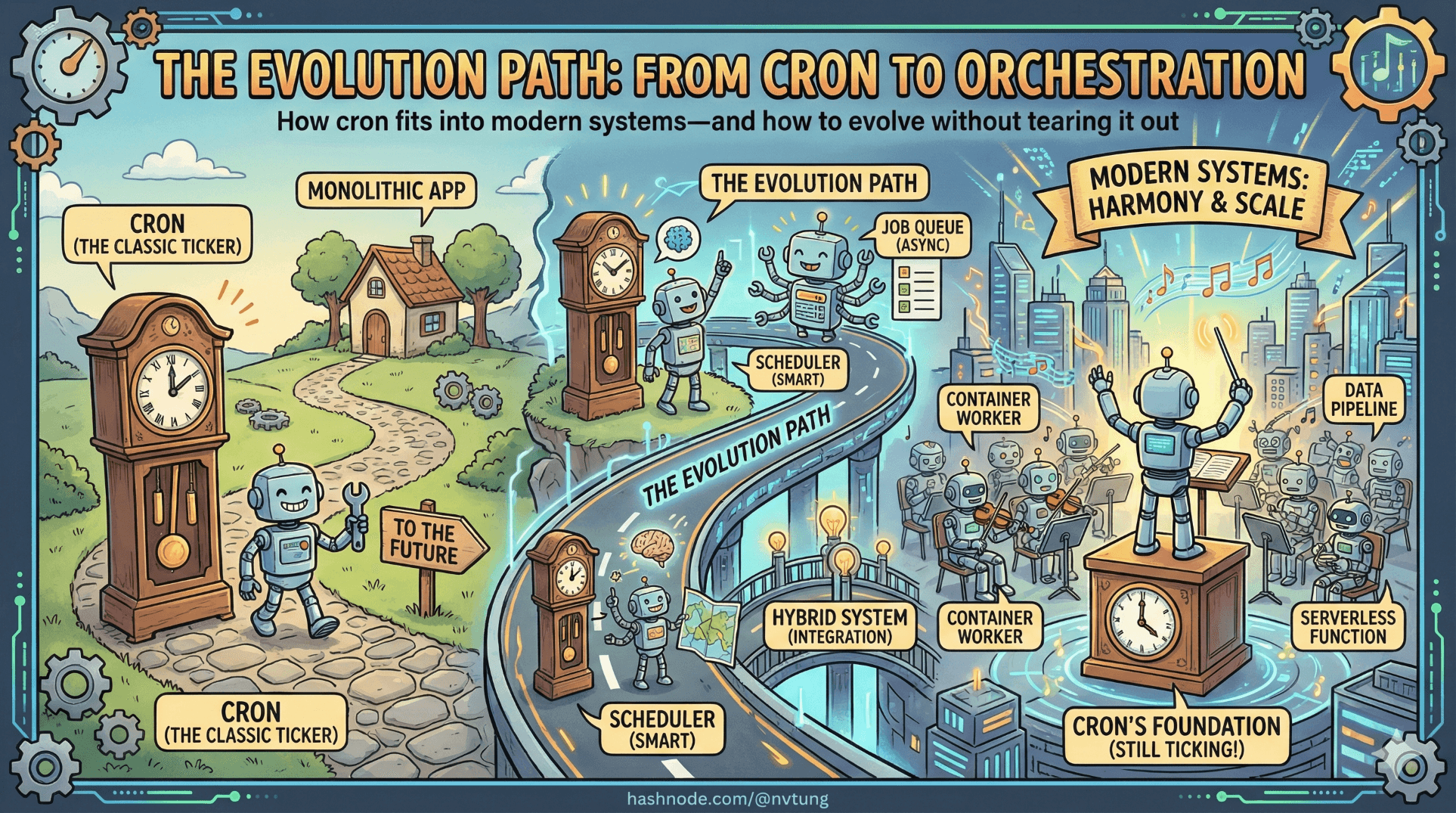
Cron has a strange reputation arc. Early in a system’s life, it feels empowering. Later, it’s blamed for things it never promised to do. Somewhere in the middle, teams either replace it wholesale—or quietly keep it while pretending they didn’t.
The truth is less dramatic. Cron doesn’t become obsolete; systems outgrow what they ask cron to do.
This final article is about placing cron correctly in the modern ecosystem: knowing when it’s enough, when it needs help, and how to evolve without ripping out the foundation you’ve already built.
When Cron Is Enough
Cron is enough when time-based intent is simple and execution is bounded.
In the system described earlier—built with Yii and HumHub—cron remained effective because it stayed within its competence:
Schedules were coarse (minute-level, not second-level)
Jobs were idempotent
Heavy work was delegated
The number of scheduling entry points was small
Operational expectations were clear
A setup like this is not fragile. It’s boring. And boring infrastructure ages well.

If your system:
Runs on a small number of hosts
Has predictable workloads
Can tolerate minute-level latency
Already separates scheduling from execution
Then cron is not your bottleneck. Complexity elsewhere will hurt you first.
When Cron Starts to Feel Tight
Cron starts to feel constraining when execution outpaces scheduling.
Common signals include:
Queues growing faster than they drain
Jobs overlapping more often than expected
Pressure to reduce latency below one minute
Multiple machines needing coordination
Manual reruns becoming operationally risky

None of these mean cron is “bad.” They mean cron is being asked to coordinate behavior across time, load, and topology—which is beyond its remit.
This is the point where you add layers, not replacements.
Adding Persistent Workers
The first evolution is usually not replacing cron, but removing its loop overhead.
In earlier examples, async jobs were processed like this:
* * * * * php yii queue/run
This works well, but it has a cost:
PHP boots every minute
Configuration reloads every minute
Cold starts dominate short jobs
With higher volume, the natural step is persistent workers.
Conceptually, the code doesn’t change:
Yii::$app->queue->push(new SendNotificationJob([
    'userId' => $userId,
]));
What changes is how workers run:
Long-lived processes
Managed by a supervisor
Restarted on failure
Scaled horizontally
Cron still matters here. It often remains responsible for:
Kicking off workers if they die
Scheduling low-frequency maintenance tasks
Acting as a safety net
Cron steps back from execution, not from scheduling.
Introducing Distributed Queues
The next pressure point is distribution.
As soon as multiple machines process jobs, new questions appear:
Who owns which jobs?
How are retries coordinated?
How do you prevent double execution?
Distributed queues answer these questions by centralizing state.
From the application’s point of view, nothing dramatic changes:
Yii::$app->queue->push(new RebuildIndexJob([
    'resourceId' => $id,
]));
But operationally:
Workers can live anywhere
Failures are isolated
Throughput scales independently of scheduling
Cron’s role narrows again:
Trigger periodic enqueues
Schedule reconciliation or cleanup
Act as a time-based initiator
The system becomes event-heavy, but cron still provides temporal structure.
Cloud Schedulers: Cron, With a Different Accent
Cloud schedulers often get framed as “replacing cron.” They don’t. They externalize it.
A cloud scheduler:
Triggers execution based on time
Runs independently of your hosts
Integrates with managed services
What changes is where the clock lives, not the concept.
Instead of:
* * * * * php yii cron/run
You get:
A managed time trigger
Calling an endpoint
Or invoking a job runner
The same design questions remain:
What happens if execution is delayed?
How do you ensure idempotency?
Where does state live?
Cloud schedulers reduce operational burden, not architectural responsibility.
Migration Strategies That Don’t Hurt
The biggest mistake teams make is trying to “modernize” cron in one leap.
The safer pattern is progressive delegation.
Start by isolating scheduling intent
If schedules live in crontab entries scattered across servers, centralize them in application code first.Delegate execution gradually
Move heavy logic behind queues or workers without changing cron triggers.Introduce persistence where it helps
Replace minute-based polling with long-lived workers only when startup cost dominates.Externalize time last
Move the clock out of the OS only when infrastructure maturity supports it.

At no point do you need to declare cron “deprecated.” You just ask it to do less.
Hybrid Models: Cron + Event-Driven Systems
In mature systems, cron rarely disappears. It becomes one trigger among many.
A common hybrid looks like this:
Events trigger most work
Queues handle execution
Workers process continuously
Cron handles:
Reconciliation
Cleanup
Periodic audits
Safety checks

Cron becomes the system’s conscience—periodically asking, “Is reality still consistent with our assumptions?”
That role doesn’t go away, no matter how event-driven you become.
Knowing Cron’s Proper Place
Cron’s proper place is not at the center of execution.
It’s at the boundary between time and intent.
It answers:
- When should something be considered?
It does not answer:
How should it scale?
How should it recover?
How should it coordinate across machines?
The moment you expect cron to answer those questions, you’re setting yourself up for disappointment.

But when you let cron do exactly what it’s good at—and no more—it remains one of the most stable pieces of infrastructure you’ll ever rely on.
The Quiet Ending
There’s a reason cron survives every architectural fashion cycle. It encodes a truth that doesn’t age: time keeps passing, whether your system reacts or not.
Modern orchestration doesn’t replace that truth. It builds around it.
If readers walk away from this series with one instinct sharpened, let it be this:
Don’t ask cron to be clever. Ask it to be punctual—and design everything else to handle the consequences.
That’s not nostalgia.
That’s systems thinking.
☰ Series Navigation
Core Series
Part 2: Anatomy of a Cron Job
Part 5: HumHub & Yii: Design Intent Behind the Cron Architecture
→ Part 8: The Evolution Path: From Cron to Orchestration